
Dry Eye Lubricant Selector
Find Your Perfect Eye Drops
Answer these questions to get personalized lubricant recommendations based on your symptoms and lifestyle
Your Recommendations
When your eyes feel gritty, burn, or water uncontrollably, it’s not just being tired. It’s dry eye disease - a real, measurable condition that affects millions. According to the Tear Film & Ocular Surface Society, over 16 million adults in the U.S. alone have it, and globally, the numbers range from 5% to 50% of the population depending on where you live. In New Zealand, with our dry winters and indoor heating, it’s more common than most people realize. The good news? You don’t have to just live with it. There are real, science-backed ways to manage it - starting with lubricants and humidifiers.
What Exactly Is Dry Eye?
Dry eye isn’t just about not having enough tears. It’s about tears that don’t work right. Your tear film has three layers: oil, water, and mucus. If the oil layer is thin or missing - which happens in 86% of cases - your tears evaporate too fast. That’s evaporative dry eye. If your body just doesn’t make enough water, that’s aqueous-deficient dry eye. Either way, your eyes get irritated, vision blurs, and daily life gets harder. A 2022 survey found that nearly 7 out of 10 people with dry eye say it interferes with reading, driving, or using screens. It’s not just discomfort. It’s a quality-of-life issue.
Over-the-Counter Lubricants: Not All Artificial Tears Are the Same
Most people start with OTC eye drops - the kind you can grab off any pharmacy shelf. But they’re not all created equal. The active ingredients make all the difference.
- Carboxymethylcellulose (0.5-1%) - thick, long-lasting, good for moderate dryness. Think Refresh Tears.
- Sodium hyaluronate (0.1-0.4%) - naturally found in your eyes. Gives smooth, natural relief. Often used in premium drops.
- Propylene glycol - helps retain moisture. Common in preservative-free single-dose vials.
Viscosity matters too. Low-viscosity drops (thin) give quick relief but fade fast - maybe 1-2 hours. High-viscosity gels (thick) last 4-6 hours but blur vision. Use them at night, not while driving. If you’re using contacts, wait 10-15 minutes after using drops before reinserting lenses. For Miebo, the wait is 30 minutes.
Prescription Lubricants: When OTC Isn’t Enough
If your eyes are still burning after months of OTC drops, it’s time to talk prescription. These aren’t just stronger versions - they work differently.
Restasis (cyclosporine 0.05%) - approved in 1998, now available as a generic since 2020. It doesn’t add moisture. It tells your body to make more tears by calming down inflammation in the tear glands. But it takes time. You won’t feel better for 3-6 months. And yes, many people report a burning sensation. That’s why adherence is low - only 52% stick with it at six months. Refrigerating the bottle helps reduce that sting. If you’re patient, it works. Clinical studies show a 13.9-point drop on the OSDI scale - a real, measurable improvement.
Xiidra (lifitegrast 5%) - approved in 2016. It blocks a specific inflammatory signal (LFA-1) that causes dryness. Unlike Restasis, you might feel better in as little as two weeks. But 25% of users report stinging on application. Reviews on Drugs.com average 5.6/10. People love the speed but hate the discomfort.
Miebo (perfluorohexyloctane 3.5%) - the newest player, approved in 2023. It’s not a tear replacement. It’s a protective shield. This semifluorinated alkane floats on top of your tear film like a thin oil layer, stopping evaporation instantly. In trials, users reported 1.5 times more relief than with placebo after just 15 days. Only 0.16% of patients quit because of side effects - far better than Restasis’s 17%. The downside? It costs around $650 for a 30-day supply. Insurance often requires you to try cheaper options first.
Eysuvis (loteprednol etabonate 0.25%) - a short-term steroid drop. Used for flare-ups. Only for 10 days at a time. Not for daily maintenance.
Tyrvaya (varenicline nasal spray) - yes, you spray it in your nose. It stimulates nerves that signal your eyes to make more tears. Costs about $200/month. Works for some, especially if you’re tired of putting drops in your eyes.

Humidifiers: The Simple Tool Most People Ignore
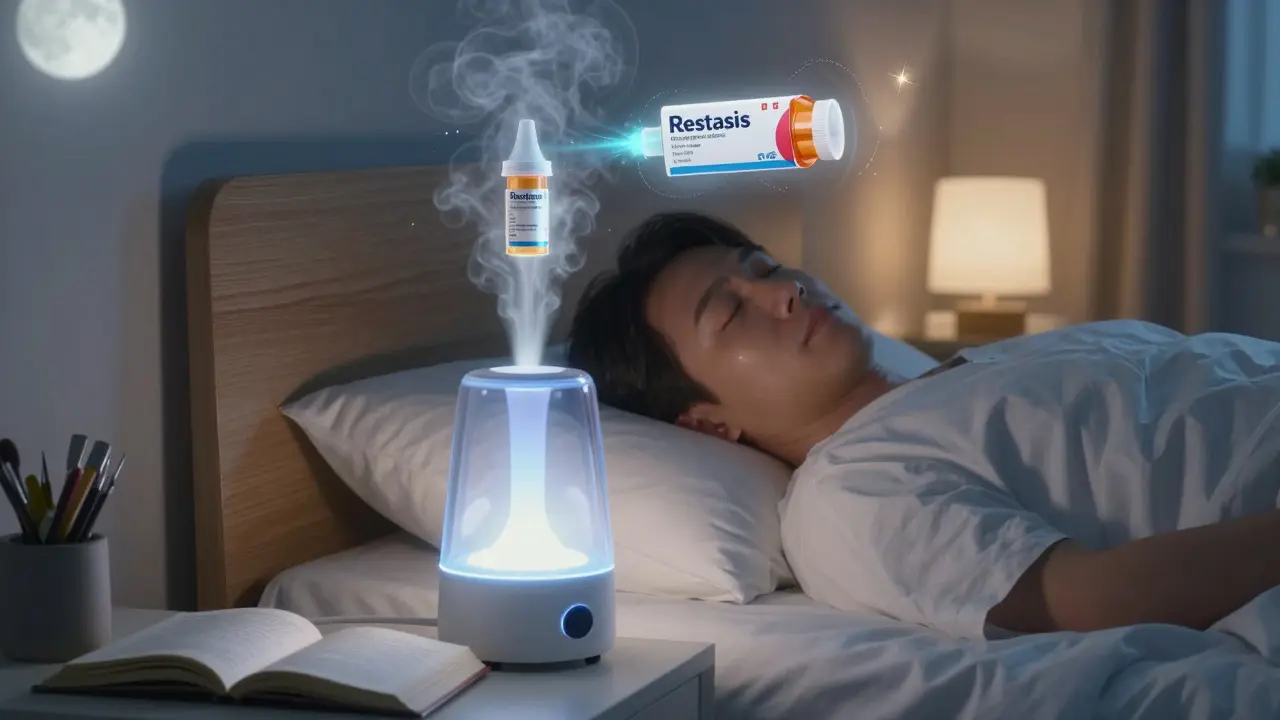
Here’s something you can do tonight: turn on a humidifier. Not a fancy one. Just any cool-mist humidifier set between 40% and 60% humidity. Why? Because dry air pulls moisture from your eyes. Indoors, especially in winter, humidity can drop below 20%. That’s like living in a desert. A 2023 survey of 342 dry eye patients found that 72% saw major improvement in nighttime symptoms after using a humidifier. No medication needed. No prescription. Just air.
Place it near your bed. Run it while you sleep. Clean it weekly - mold in humidifiers is worse than dry air. If you’re using a heater or fan, the air gets drier. A humidifier offsets that. It’s not a cure, but it’s a powerful support tool. Combine it with lubricants, and you’re attacking dry eye from two angles: surface protection and environmental control.
Choosing the Right Option for You
There’s no one-size-fits-all. Here’s how to think about it:
- Mild symptoms - start with low-viscosity OTC drops 2-4 times a day. Add a humidifier.
- Moderate to severe - try a high-viscosity gel at night. Add a humidifier. If no improvement in 4 weeks, see an eye specialist.
- Chronic inflammation - cyclosporine (Restasis) or lifitegrast (Xiidra). Be prepared to wait. Use them daily, even if you don’t feel better right away.
- Fast relief needed - Miebo. Especially if you’re on screens all day or live in a dry climate.
- Cost is a barrier - stick with generics. Cyclosporine generics cost $150-$250, not $500+. Ask about patient assistance programs.
Combination therapy works best. One patient on the Dry Eye Warriors Facebook group wrote: “I use Miebo in the morning, Restasis at night, and a humidifier while I sleep. My eyes haven’t felt this good in years.” That’s not luck. That’s strategy.
What Doesn’t Work (And Why)
Many people try home remedies - aloe vera, green tea bags, coconut oil. None of these are proven. Some can even irritate your eyes further. Don’t use tap water to rinse your eyes. Don’t skip doses because of burning. That’s how you lose progress. And don’t assume your optometrist will automatically know about Miebo or Tyrvaya. Many still default to Restasis because it’s familiar. Ask for the latest options.
Getting Started: Your Action Plan
Here’s what to do in the next 7 days:
- Buy a cool-mist humidifier. Set it to 50% humidity. Run it in your bedroom.
- Switch to preservative-free, single-use OTC drops if you’re using multi-dose bottles. They’re gentler.
- Start a symptom journal. Note when your eyes feel worst - morning? After screens? In air-conditioned rooms?
- Visit an eye care professional. Ask for a tear film break-up time test and Schirmer test. These measure your tear stability and production.
- If your symptoms are moderate to severe, ask about cyclosporine or lifitegrast. Don’t be afraid to ask about Miebo - even if it’s expensive.
Progress isn’t overnight. But consistency beats intensity. Use your drops daily. Keep your humidifier running. Track your progress. You’ll know it’s working when you can read for 20 minutes without blinking hard, or when you wake up without that gritty feeling.
What’s Next?
The dry eye market is growing fast. By 2029, it’ll be worth nearly $8 billion. New treatments are coming - like Reproxalap, which reduces redness and boosts tear production. In the next five years, personalized treatment based on tear analysis (like TearLab’s osmolarity test) will become standard. But right now, the tools we have - lubricants and humidifiers - are powerful enough to change your daily life.
Can I use artificial tears every day?
Yes. Most OTC lubricants are safe for daily use. Preservative-free single-use vials are ideal if you’re using them more than four times a day. Avoid drops with preservatives like benzalkonium chloride if you’re using them frequently - they can irritate your eyes over time.
Why does my eye burn when I use Restasis?
Restasis contains cyclosporine, which can cause temporary stinging or burning because it’s an immune-modulating drug. This usually improves after a few weeks. Refrigerating the bottle before use can reduce the discomfort. If it’s unbearable, talk to your doctor about switching to Xiidra or Miebo.
Do humidifiers really help dry eyes?
Yes, especially in dry climates or heated indoor spaces. A 2023 survey of dry eye patients showed that 72% had better nighttime symptoms with a humidifier set between 40-60% humidity. It’s not a cure, but it reduces tear evaporation - one of the main causes of dry eye.
Is Miebo worth the cost?
For people with evaporative dry eye who need fast relief, yes. Miebo works immediately by forming a protective barrier on the eye’s surface. Clinical trials show it’s better tolerated than Restasis, with far fewer side effects. If you’ve tried other drops and still feel dry, Miebo may be worth discussing with your doctor - especially if your insurance covers it or you qualify for a patient assistance program.
How long does it take for prescription eye drops to work?
It varies. Xiidra can show improvement in as little as two weeks. Restasis takes 3-6 months. Miebo works within hours. The key is consistency. Stopping because you don’t feel better right away means you won’t get the long-term benefits. Stick with it for at least 4-6 weeks before deciding if it’s working.


Evaporative dry eye isn't just about tear volume-it's about lipid layer integrity. If your meibomian glands are clogged, no amount of hyaluronic acid will fix it. You need thermal pulsation therapy or lid hygiene. OTC drops? Band-aids on a hemorrhage.
And humidifiers? Absolutely. But only if paired with nasal breathing. Mouth breathers get zero benefit. Train yourself.
Consistency > intensity. Daily drops, nightly heat packs, weekly lid scrubs. That’s the triad.