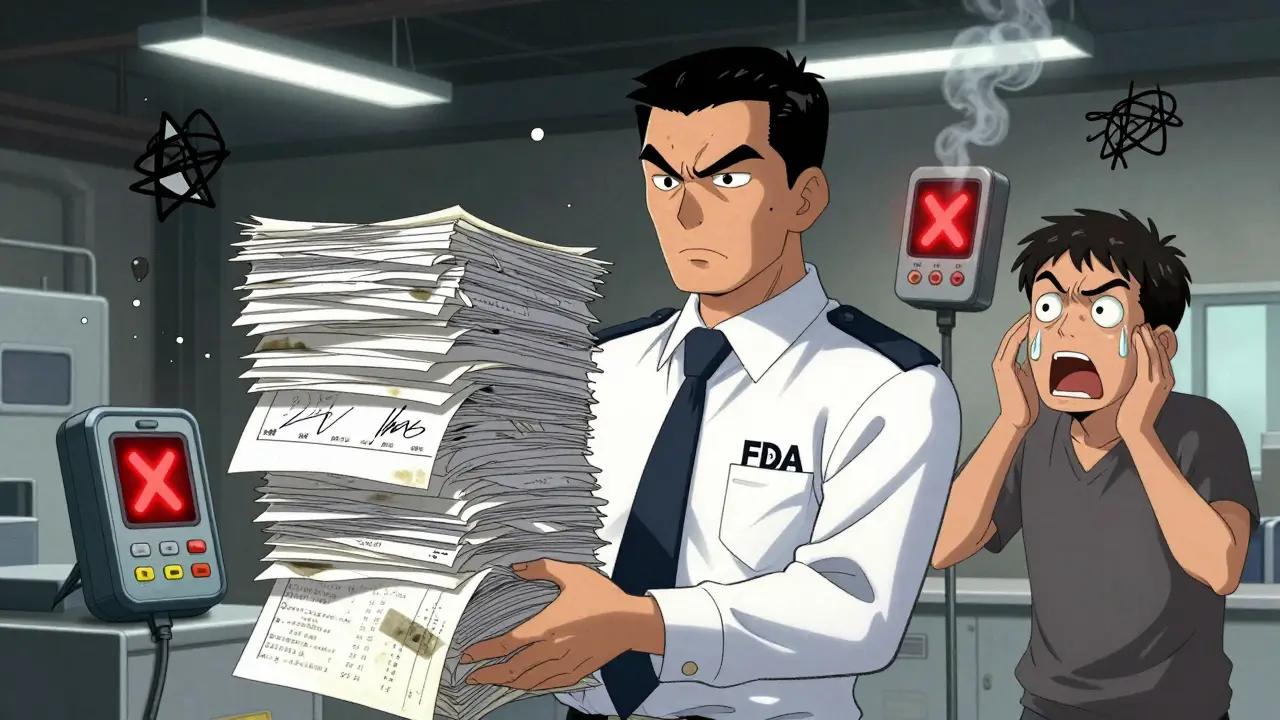
When a batch of medicine or medical device fails, regulators don’t just look at the equipment or the raw materials. They look at the paperwork. Not because it’s bureaucracy for bureaucracy’s sake, but because bad records mean bad products - and bad products can kill people.
In manufacturing, especially in pharmaceuticals, medical devices, food, and cosmetics, documentation isn’t a side task. It’s the backbone of quality. If you didn’t write it down, regulators assume it never happened. And if it wasn’t written down correctly, your entire batch could be destroyed - or worse, shipped to patients who rely on it.
What Exactly Do Regulators Require?
The global standard for manufacturing documentation is built on Good Manufacturing Practices (GMP). These rules aren’t suggestions. They’re legally enforceable. The U.S. FDA’s 21 CFR Part 211, the EU’s EudraLex Volume 4, and the PIC/S guidelines used by 56 countries all demand the same core idea: every step must be recorded, and every record must be trustworthy.
There are two types of documents you need:
- Procedural documents: These are your instructions - Standard Operating Procedures (SOPs), test methods, material specs, and bills of materials. They tell people how to do the job.
- Compliance records: These are what you actually write down while doing the work - batch records, environmental logs, equipment usage, test results, and signatures.
These records must follow the ALCOA+ principles:
- Attributable: Who did it? Every entry must have a name or electronic signature.
- Legible: Handwritten? Clear ink, no smudges. Electronic? No typos or corrupted files.
- Contemporaneous: Written at the time the work was done - not hours later, not the next day. Regulators expect records created within 24 hours.
- Original: No photocopies of handwritten notes. No transcribing from sticky notes into a logbook. The first record is the only one that counts.
- Accurate: No guessing. No rounding unless allowed. If a temperature was 22.7°C, you write 22.7°C.
- Complete, Consistent, Enduring, Available: All data must be there, match up, last for years, and be easy to find when auditors show up.
What Happens When Records Are Bad?
In 2021, 87% of FDA warning letters were issued because of documentation failures - not because a machine broke, not because a worker was careless, but because the paper trail didn’t hold up. That’s the real risk.
Here are the top three documentation problems regulators see:
- Incomplete batch records (32% of citations): Missing timestamps, skipped tests, unsigned approvals. If a step wasn’t recorded, regulators assume it wasn’t done.
- Inadequate investigation documentation (27%): A deviation happened, but you didn’t fully trace why, what you did, or how you prevented it. A quick fix isn’t enough - you need proof you looked deeper.
- Untimely record completion (21%): Workers wait until the end of the shift, or even the next day, to fill out logs. That’s a red flag. Contemporaneous means right now.
One company lost $15 million because a warehouse temperature logger wasn’t documented during a 48-hour power outage. The product was recalled. The FDA issued a warning letter. The CEO had to explain it to shareholders.
Digital vs. Paper: Which Is Better?
Most manufacturers are moving to electronic systems - but not because they’re trendy. Because paper fails.
Electronic Quality Management Systems (eQMS) reduce documentation errors by 55% on average. Why? They prevent:
- Handwriting mistakes
- Lost paper logs
- Back-dated entries
- Missing signatures
But going digital isn’t just clicking “save.” Your system must be validated. That means:
- It’s tested for security - only authorized people can change records.
- Audit trails are enabled - every edit, delete, or signature is logged with who, when, and why.
- It meets 21 CFR Part 11 - electronic signatures must be tied to a person’s identity, not just a username.
Merck cut their CAPA closure time from 45 days to 22 after switching to MasterControl. That’s not just efficiency - it’s risk reduction.
But here’s the catch: 68% of companies lose data during system migrations. If you’re switching from paper to digital, you need a full data migration validation plan. Every record must be transferred correctly - no exceptions.

Regional Differences You Can’t Ignore
Just because you’re following the FDA doesn’t mean you’re compliant in Europe or Japan.
- U.S. (FDA): Requires a second person to verify all calculations. No automation can replace that.
- EU: Allows electronic verification without manual checks - more flexible, but still strict on audit trails.
- Japan (PMDA): All documentation submitted locally must be in Japanese. English-only records won’t fly.
- Medical devices: ISO 13485 demands traceability from design specs to final test results. If you can’t prove a part was tested against its requirement, your device isn’t approved.
Manufacturers targeting both U.S. and EU markets spend an average of $2.1 million a year just to reconcile documentation differences. It’s not a cost of doing business - it’s a cost of misunderstanding the rules.
How to Get It Right
Successful manufacturers follow the “5C” rule:
- Clear: SOPs written at an 8th-grade reading level. No jargon. If your line worker can’t understand it, it’s too complex.
- Concise: One page per procedure if possible. If it’s longer, break it into steps.
- Complete: Every data point required by the regulation is captured - no shortcuts.
- Correct: Numbers, units, names - all verified. Double-check everything.
- Compliant: Every record follows ALCOA+ and retention rules (minimum 1 year beyond product expiration).
Also:
- Use the “four-eyes principle”: Two people review critical records before final approval.
- Appoint “documentation champions” in each department - someone who owns the quality of records in their area.
- Train staff not just on how to fill out forms, but on why it matters. People follow rules when they understand the stakes.
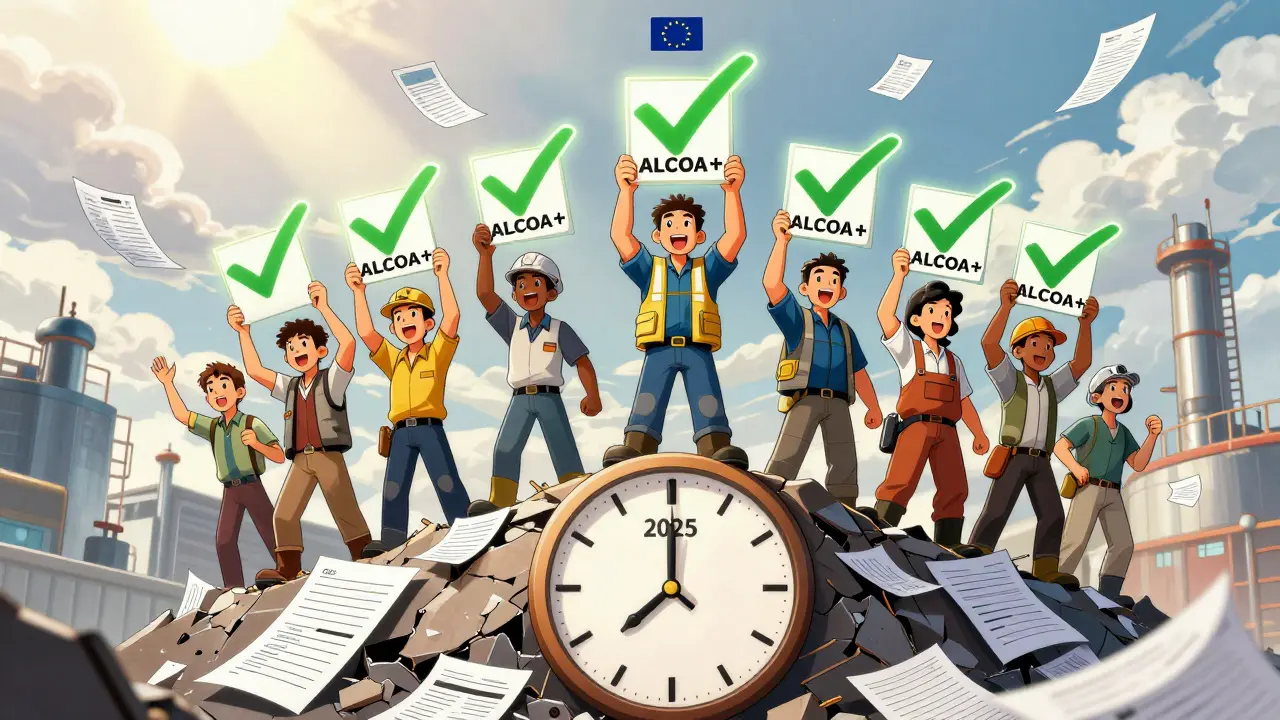
What’s Changing in 2025?
Regulators aren’t slowing down. In fact, they’re getting smarter.
- The EU’s 2024 revision of EudraLex will require manufacturers to document risk assessments for every critical documentation process - starting January 2025.
- The FDA’s 2023 draft guidance now requires audit trails to hold at least 1,000 characters per entry. That means if you edit a temperature reading, you must explain why.
- AI tools are starting to auto-generate batch records from machine data. Early adopters cut documentation time by 45%. But regulators haven’t approved them yet - validation is still the hurdle.
By 2027, the global market for GMP documentation software will hit $5.1 billion. That’s not because companies are being forced - it’s because they’ve seen the cost of getting it wrong.
Final Reality Check
Documentation isn’t about filling out forms. It’s about proving you controlled the process. Every signature, every timestamp, every number - it’s evidence.
Quality isn’t something you inspect at the end. It’s built into every step. And if you didn’t document it, you didn’t build it.
There’s no shortcut. No magic tool. No exception. If your records aren’t clean, your product isn’t safe. And in manufacturing, that’s not just a compliance issue - it’s a moral one.
What happens if I don’t follow GMP documentation rules?
Regulators can issue Form 483 observations, warning letters, or even shut down your facility. Product recalls are common - and they cost an average of $10 million per incident. In severe cases, executives can face personal liability. More than 87% of FDA warning letters in 2021 were due to documentation failures.
Do I need to keep paper records if I use electronic systems?
No - if your electronic system is validated and meets 21 CFR Part 11, paper backups aren’t required. But if you’re using a hybrid system (paper + electronic), you must ensure both are synchronized. The original record - whether digital or paper - is the one that counts. Never rely on handwritten notes as backups.
How long do I need to keep manufacturing records?
Minimum 1 year beyond the product’s expiration date. For some medical devices or pharmaceuticals, regulators may require 3 years after the last distribution. Always check your region’s rules - EU, FDA, and PIC/S have slight variations.
Can I use AI to generate my batch records?
Not yet for regulatory purposes. While AI tools can reduce documentation time by up to 45%, regulators require full validation of any automated system. Until AI-generated records are validated under GAMP 5 and accepted by FDA or EMA, human review and approval are still mandatory.
Why do SOPs need to be written at an 8th-grade level?
Because complex language leads to mistakes. If a worker misunderstands a procedure, the batch could be contaminated. The FDA explicitly recommends simple language to prevent misinterpretation. Clear instructions reduce errors, improve compliance, and save money on recalls.
What’s the biggest mistake manufacturers make with documentation?
Waiting until the end of the shift to fill out records. Contemporaneous means right after the task. Delayed entries are the #1 reason for audit failures. Train staff to document as they go - not as a chore at the end of the day.


This is SO important!! 🙌 I work in pharma QA and let me tell you - one missing signature can derail an entire audit. I’ve seen teams lose weeks just fixing back-filled logs. Seriously, document AS YOU GO. It’s not a chore - it’s your shield. 🛡️💕