
Imagine getting a bill for your monthly medication that looks like a mortgage payment. For patients dealing with complex conditions like cancer, rheumatoid arthritis, or multiple sclerosis, this isn't a nightmare scenario-it's Tuesday. Specialty medications are high-cost pharmaceutical products typically used to treat complex, chronic conditions, often requiring special handling, administration, and monitoring. These drugs make up only about 2% of all prescriptions filled, yet they account for roughly half of total pharmacy spending. With the market growing from $48 billion in 2010 to over $200 billion in 2022, understanding how to manage these costs is no longer just a nice-to-have; it’s essential.
The challenge isn't just the price tag on the bottle. It’s the entire ecosystem around these drugs. Many require injections or infusions, need refrigeration, and demand close clinical supervision. If you’re an employer designing a benefits plan, a healthcare administrator, or even a patient trying to navigate coverage, the question is the same: How do we keep people healthy without bankrupting them? The answer lies in moving away from reactive billing and toward proactive management strategies that align clinical outcomes with financial reality.
Understanding the Specialty Drug Landscape
To cut costs, you first have to understand what you’re paying for. Unlike generic pills you pick up at a corner pharmacy, specialty drugs are managed differently. They are often dispensed through specialized pharmacies that offer support services, such as nurse hotlines, delivery tracking, and adherence counseling. This service layer adds value but also complexity.
Consider the sheer volume of growth. Annual growth rates for specialty drugs average between 10% and 12%, compared to 3-5% for traditional pharmacy benefits. Employers face an average spend of $34.50 per member per month (PMPM) on these drugs alone. When you look at injectables specifically, the site of care matters immensely. Administering a drug in a hospital outpatient department can cost significantly more than doing it in a physician’s office or at home, even if the drug itself is identical. Understanding these distinctions is the first step in identifying where money is leaking out of the system.
Leveraging Biosimilars for Immediate Savings
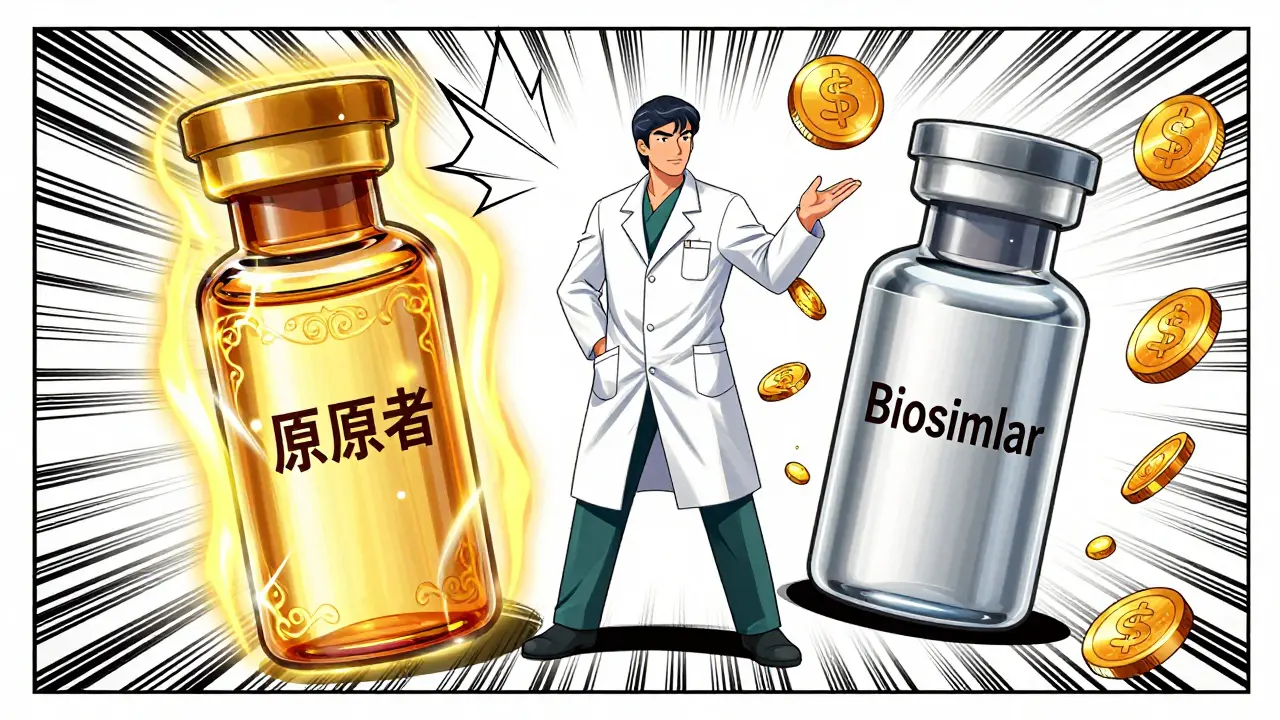
If there is one silver bullet in the fight against high drug prices, it’s Biosimilars are biological medical products that are highly similar to an already approved reference biologic product. Think of them as the generic version of biologics. While generics are chemically identical copies of small-molecule drugs, biosimilars are large, complex molecules that are "similar" rather than identical, but clinically equivalent.
The savings potential here is massive. FDA-approved biosimilars cost, on average, 50% less than their reference biologic counterparts. Industry-wide, adopting these alternatives could save $180 billion over five years. Yet, adoption rates remain below 30% for many therapeutic categories. Why? Often, it comes down to prescriber familiarity and patient acceptance. Doctors may stick to the brand-name drug they’ve used for years, and patients might fear switching mid-treatment.
However, hospitals that implement structured transition programs see success. By educating providers and ensuring seamless switches, systems have achieved 20-30% cost reductions for equivalent therapeutic outcomes. If you are managing a formulary, prioritizing biosimilar inclusion and encouraging prescribers to switch eligible patients is one of the highest-impact moves you can make.
| Attribute | Originator Biologic | Biosimilar |
|---|---|---|
| Average Cost | High (Reference Price) | ~50% Lower |
| Clinical Efficacy | Proven | Clinically Equivalent |
| Adoption Rate | Dominant | <30% (Growing) |
| Regulatory Pathway | Full BLA Approval | Abbreviated Approval |
Optimizing the Site of Care
Where a patient receives their injection or infusion changes the bottom line dramatically. This is known as treatment setting optimization. Data shows that for 63% of specialty drug costs, hospital-based administration isn’t clinically necessary. Moving these procedures to lower-cost settings-like medical offices or home health services-can reduce costs by 48%.
Prime Therapeutics reported seeing 40-50% cost reductions when shifting infusion services from hospital outpatient departments to physician offices or home settings. The key is establishing fair and competitive fee schedules across all sites of care. If hospitals charge premium rates regardless of complexity, providers have little incentive to move care elsewhere. By creating financial incentives for lower-cost settings, payers and employers can drive significant savings without compromising patient safety.
Strategic Formulary Management
You can’t let every expensive drug flow freely without oversight. Effective Formulary management involves the process of selecting and organizing which medications are covered by a health plan, often using tools like prior authorization and step therapy. This doesn’t mean denying care; it means ensuring the right drug is used for the right patient at the right time.
Tools like prior authorization (PA), quantity limits, and step therapy protocols help prevent inappropriate use. For example, Excellus BlueCross BlueShield implemented a structured PA process for GLP-1 weight loss medications, generating $13.64 PMPM in savings compared to national PBM formularies. The goal is to filter out wasteful spending while maintaining access for those who truly need specific therapies. Successful programs require dedicated Pharmacy and Therapeutics (P&T) committees with unbiased pharmacists reviewing cases. For every 100,000 covered lives, you’re looking at needing about 15-20 full-time equivalent staff to manage this effectively.
Narrowing Pharmacy Networks
Not all specialty pharmacies are created equal. Some offer better pricing, better clinical support, and better data integration than others. By limiting your network to a smaller number of preferred providers, you can leverage volume to negotiate better rates. CarelonRx reports that narrow networks typically result in 10-15% lower contractual rates while improving clinical service quality.
Quantum Health found that exclusive specialty pharmacy networks generated $1.37 PMPM in savings across 200 employers. That might sound small per person, but scale it up, and it’s millions of dollars annually. The trade-off is patient choice. Some members resist being funneled into specific pharmacies. However, when done right-with clear communication and superior support services-patient satisfaction can actually increase. Patients using preferred networks reported higher satisfaction scores (8.7/10 vs. 7.2/10) due to enhanced clinical support, despite some frustration with limited options.
Maximizing Financial Assistance and Rebates
Don’t leave money on the table. Manufacturer copay assistance programs can cover deductibles and out-of-pocket maximums, but if not managed correctly, this money goes to the manufacturer, not the payer. Pharmacy copay maximizer programs ensure that non-needs-based manufacturer assistance counts toward members' deductibles, enabling $0 out-of-pocket costs for members while reducing the employer’s portion of the bill.
Additionally, maximizing rebate potential through Prescription Benefit Managers (PBMs) can reduce net costs by 5-8% annually. Strong provider agreements with specific rebate structures are critical here. You need contracts that guarantee you get the rebates you’re owed, and you need visibility into whether those rebates are actually being passed back to you.
Implementation Challenges and Solutions
Knowing what works is one thing; doing it is another. Implementing these strategies requires operational alignment. Narrow network rollouts take 6-9 months of planning, including contract negotiations and member education. Expect initial resistance. Children's Hospital Association noted that 22% of employers saw increased call center volume during transitions. Prepare your customer service teams.
Prior authorization can be a pain point for physicians. ASHP surveys show that while 68% of doctors agree PAs prevent inappropriate use, 54% report administrative burden. To mitigate this, streamline the process. Use real-time data and integrate with electronic health records so clinicians can submit requests easily. Quantum Health emphasizes that effective programs need real-time insights to enable early intervention, requiring integration with major EHR systems.
Initial implementation costs range from $50,000 to $250,000 depending on plan size, but the return on investment typically arrives within 12-18 months. It’s an upfront investment for long-term stability.
Looking Ahead: Policy and Market Trends
The landscape is shifting. The Inflation Reduction Act’s Medicare drug price negotiation provisions are influencing private market strategies. Experts suggest expanding these provisions to include more drugs and mandate negotiated prices for private insurers. Meanwhile, CMS plans to test grouping originator biologics and biosimilars under the same Medicare Part B reimbursement code-a policy rated as highly feasible and impactful by expert panels.
Value-based contracting is also gaining traction, with a 45% year-over-year increase in arrangements for specialty medications. This approach aligns drug costs with actual therapeutic outcomes, rewarding manufacturers only when patients improve. As the market consolidates-with CVS, Express Scripts, and Walgreens controlling over 50% of distribution-employers must become smarter buyers. Integrated care models that combine pharmacy and medical benefit management will likely become the standard, unlocking lower net costs for 60-70% of specialty drugs by 2026.
What are specialty medications?
Specialty medications are high-cost drugs used to treat complex, chronic conditions like cancer, rheumatoid arthritis, and multiple sclerosis. They often require special handling, administration (such as injections), and ongoing monitoring by healthcare professionals.
How much do biosimilars save compared to brand-name biologics?
On average, FDA-approved biosimilars cost about 50% less than their reference biologic drugs. Widespread adoption could save the industry $180 billion over five years.
Why does the site of care matter for injectables?
The location where an injectable is administered significantly impacts cost. Administering drugs in hospital outpatient departments is often much more expensive than in physician offices or at home. Shifting care to lower-cost settings can reduce expenses by 40-50% without affecting clinical outcomes.
What is formulary management?
Formulary management is the process of determining which drugs are covered by a health plan. It uses tools like prior authorization, step therapy, and quantity limits to ensure appropriate use and control costs, potentially saving thousands per member per year.
How can narrow pharmacy networks reduce costs?
By limiting the number of specialty pharmacies in a network, payers can negotiate lower contractual rates (typically 10-15% lower) and improve clinical service quality through focused relationships with preferred providers.