
Imagine spending $150 million to develop a life-saving treatment for a disease that affects only 8,000 people in the entire United States. Without special legal protections, generic competitors could flood the market the moment your patent expires-or even before-making it impossible to recoup those costs. This is exactly why orphan drug exclusivity exists. It is not just a regulatory footnote; it is the financial engine that makes developing treatments for rare diseases possible.
For decades, pharmaceutical companies ignored rare diseases because the patient populations were too small to generate profit. Then came the Orphan Drug Act of 1983. Since then, the landscape has shifted dramatically. Today, orphan drugs account for more than a quarter of global prescription sales. But how does this protection actually work? Who gets it? And when does it end? Let’s break down the mechanics of this critical system.
What Is Orphan Drug Exclusivity?
At its core, orphan drug exclusivity is a period of market protection granted by the U.S. Food and Drug Administration (FDA). It lasts for seven years from the date the FDA approves a New Drug Application (NDA) or Biologics License Application (BLA). During this window, the FDA cannot approve another company’s application for the same drug for the same specific rare disease indication, unless the new applicant can prove their version is clinically superior.
This is different from a patent. A patent protects the chemical composition or manufacturing process of a drug. Orphan exclusivity protects the use of the drug for a specific condition. You can have a drug with no remaining patent life but still enjoy seven years of orphan exclusivity for a newly discovered rare-disease indication. Conversely, you might have strong patent protection but no orphan exclusivity if the disease isn’t classified as “rare.”
| Feature | Patent Protection | Orphan Drug Exclusivity |
|---|---|---|
| Duration | Typically 20 years from filing | 7 years from FDA approval |
| Scope | Covers the molecule/process | Covers the specific drug-disease pair (the "dyad") |
| Requirement | Novelty, non-obviousness, utility | Disease affects <200,000 people in US OR inability to recover costs |
| Competitor Entry | Blocked until expiration or invalidation | Blocked unless clinical superiority is proven |
The "Dyad" Concept: Why Specificity Matters
To understand orphan exclusivity, you need to understand the term “dyad.” In regulatory speak, a dyad is the combination of a specific drug and a specific disease indication. Exclusivity applies only to that pair. If Company A gets approval for Drug X to treat Disease Y, they get seven years of exclusivity for that exact combination.
Here is where it gets tricky. If Company B wants to sell Drug X for Disease Z, they do not need to wait out Company A’s exclusivity period, provided Disease Z is also a rare disease and Company B gets its own orphan designation. Similarly, if Drug X is approved for both a common disease and a rare disease, generics can enter the market for the common disease use immediately after patent expiry, while the innovator retains exclusivity for the rare disease use.
This specificity prevents monopolies on the drug itself while still rewarding innovation for underserved conditions. It means multiple companies can pursue the same molecular entity for different rare indications, creating a competitive environment that benefits patients in the long run.
How to Qualify for Orphan Designation
Not every drug for a small population qualifies automatically. To receive orphan designation, a sponsor must meet strict criteria defined by the Orphan Drug Act:
- Prevalence Threshold: The disease or condition must affect fewer than 200,000 people in the United States.
- Economic Viability: Alternatively, the disease may affect more than 200,000 people if there is no reasonable expectation that the cost of developing and marketing the drug in the U.S. will be recovered from U.S. sales.
The application process is strategic. Most sponsors submit their orphan designation request during Phase 1 or early Phase 2 clinical trials. Why so early? Because the clock for exclusivity starts at approval, but the designation itself takes about 90 days to review. Getting designated early locks in eligibility and allows the company to access other incentives, such as tax credits for clinical trial costs and waivers for user fees.
The FDA’s Office of Orphan Products Development (OPDP) reviews these applications with a high approval rate-around 95% for submissions that properly demonstrate prevalence data. However, proving the prevalence number requires robust epidemiological studies. You can’t just guess; you need solid data showing the patient count falls below the 200,000 threshold.

The "Winner Takes All" Horse Race
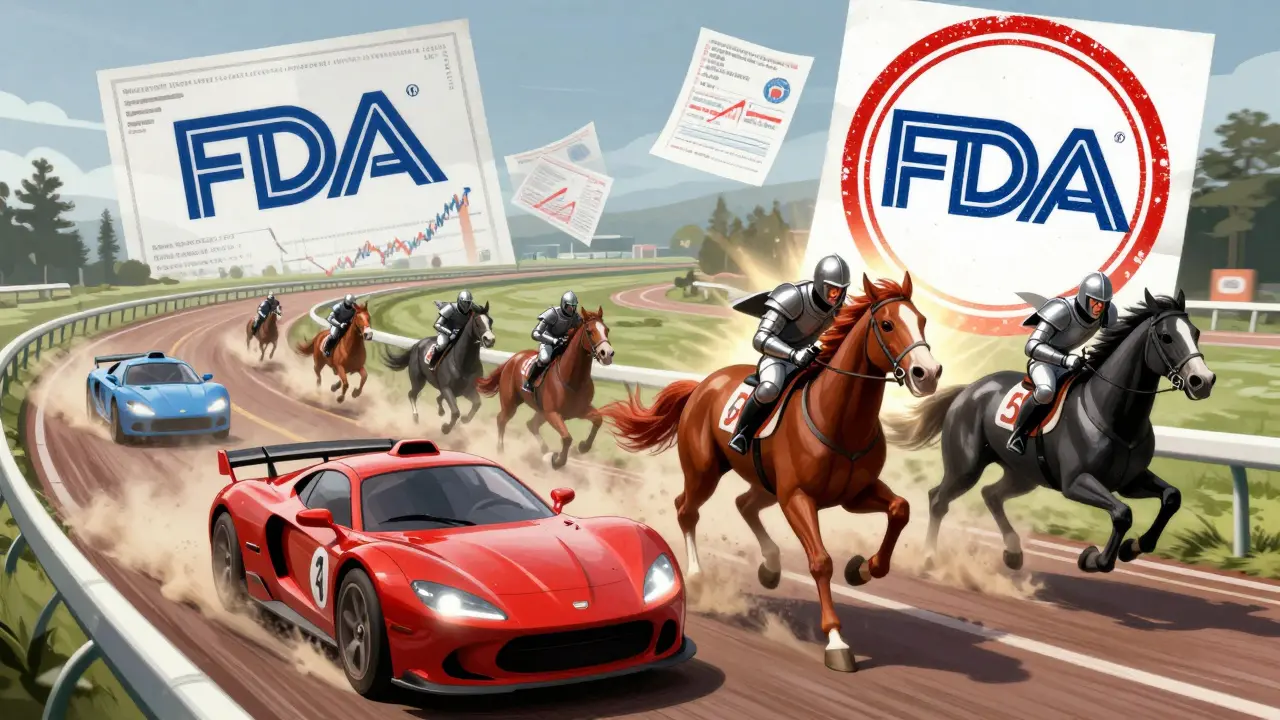
One of the most controversial aspects of orphan exclusivity is the “first-to-market” rule. Multiple companies can receive orphan designation for the same drug and the same disease. They all line up at the starting gate. But only the first one to cross the finish line-meaning the first one to get full FDA marketing approval-wins the seven-year exclusivity period.
Dr. Tim Cote, former Director of OPDP, describes this as a “horse race.” It creates intense competition. Companies rush to complete trials and submit NDAs/BLAs, knowing that being second place means losing exclusive rights. This can lead to inefficiencies, with multiple groups duplicating research efforts. However, it also drives speed. Patients often benefit from faster access to therapies because companies are motivated to move quickly.
If a second company wants to enter the market after the first winner, they face a steep hurdle: they must prove “clinical superiority.” This doesn’t mean slightly better side effects. It means demonstrating a substantial therapeutic improvement-such as greater efficacy, safety in administration, or contribution to public health. Since 1983, this standard has been met in only three documented cases. For most drugs, the first mover keeps the monopoly for the full seven years.
Orphan Exclusivity vs. Global Standards
The U.S. system is not unique. The European Union has its own framework, administered by the European Medicines Agency (EMA). While the principles are similar, the details differ significantly.
| Feature | United States (FDA) | European Union (EMA) |
|---|---|---|
| Standard Period | 7 years | 10 years |
| Extensions | None | +2 years if pediatric studies are completed per agreed plan |
| Reductions | None | Reduced to 6 years if product generates exceptional revenue |
| Definition of Rare | <200,000 in U.S. | Affects no more than 5 in 10,000 persons in EU |
The EU’s longer baseline period offers more protection, but it comes with strings attached. If a drug becomes unexpectedly profitable, the EMA can reduce the exclusivity period from ten to six years under Article 8(2) of the Orphan Regulation. The U.S. system lacks this automatic reduction mechanism, which some critics argue allows for excessive profits without accountability. Meanwhile, the EU’s extension for pediatric studies encourages companies to test drugs in children, a group often excluded from initial trials.
Is Orphan Exclusivity Enough?
While seven years sounds like a long time, it is often shorter than patent protection. According to an IQVIA Institute report, orphan exclusivity lasted longer than patent protection for only 60 out of 503 drugs granted orphan status between 1983 and 2018. In 88% of cases, patents remained the primary barrier to generic competition.
This raises a question: if patents do the heavy lifting, why do we need orphan exclusivity? The answer lies in the gaps. Patents can expire early due to litigation or failure to maintain them. Orphan exclusivity provides a backup layer of protection specifically tied to the regulatory approval. It also applies to biologics, where biosimilar competition rules are complex. Furthermore, for drugs developed under the “economic viability” clause (where prevalence is higher but costs are prohibitive), orphan exclusivity might be the only form of market protection available.
Industry surveys confirm its value. Tax credits and user fee waivers are highly ranked incentives, but orphan exclusivity consistently ranks as the third most significant driver for rare disease development. Without it, many small biotech firms would simply not take the risk.
Controversies and Future Reforms
The system is not perfect. Critics point to “salami slicing,” where companies seek multiple orphan designations for different indications of the same blockbuster drug. Humira, for example, received multiple orphan designations despite having a massive non-orphan market. This practice dilutes the intent of the law, which was to help neglected diseases, not to extend monopolies on profitable drugs.
In response, regulators are tightening the screws. The FDA issued draft guidance in May 2023 clarifying the “same drug” determination process, following controversies like the approval of Ruzurgi for Lambert-Eaton myasthenic syndrome. The goal is to prevent companies from using minor formulation changes to claim new exclusivity periods for essentially the same therapy.
Looking ahead, the trend is clear. Deloitte predicts that by 2027, 72% of new molecular entities approved by the FDA will have an orphan designation. As gene therapies and cell therapies become more common, the role of orphan exclusivity will evolve. These advanced therapies often target ultra-rare genetic conditions, making the exclusivity period crucial for attracting investment in high-risk, high-reward innovations.
Practical Tips for Sponsors
If you are navigating this space, here are key takeaways:
- Apply Early: Submit your orphan designation request as soon as you have preliminary data. Do not wait for Phase 3 results.
- Document Prevalence Rigorously: Use peer-reviewed epidemiological data. The FDA scrutinizes these numbers closely.
- Plan for the Dyad: Understand that exclusivity is indication-specific. Build your commercial strategy around the specific rare disease you are targeting.
- Monitor Competitors: Since it is a “first-to-market” race, keep a close eye on other sponsors pursuing the same dyad. Speed matters.
- Consider Clinical Superiority: If you are a second entrant, focus on designing trials that clearly demonstrate substantial therapeutic improvement over the existing standard of care.
Orphan drug exclusivity is a powerful tool. It balances the need for profitability with the moral imperative to treat rare diseases. While it has flaws, it remains the cornerstone of modern rare-disease drug development. For patients, it means hope. For developers, it means a viable path forward.
How long does orphan drug exclusivity last in the US?
In the United States, orphan drug exclusivity lasts for seven years from the date of FDA approval of the New Drug Application (NDA) or Biologics License Application (BLA).
Can two companies have orphan designation for the same drug and disease?
Yes, multiple companies can receive orphan designation for the same drug and disease combination. However, only the first company to receive full marketing approval from the FDA wins the seven-year exclusivity period. This is often referred to as a "winner-takes-all" scenario.
What is the difference between orphan exclusivity and a patent?
A patent protects the chemical composition or manufacturing process of a drug, typically for 20 years from filing. Orphan exclusivity protects the specific use of a drug for a rare disease indication for seven years from approval. Orphan exclusivity applies to the "dyad" (drug + disease), whereas patents apply to the molecule itself regardless of indication.
How does the EU orphan drug system compare to the US system?
The EU grants ten years of market exclusivity for orphan medicines, compared to seven years in the US. The EU system allows for a two-year extension if pediatric studies are completed, and can reduce the period to six years if the drug generates exceptional revenue. The US system does not have automatic extensions or reductions based on revenue.
What defines a "rare disease" for orphan drug purposes?
In the US, a rare disease is defined as one affecting fewer than 200,000 people annually. Alternatively, a disease may qualify if the developer cannot reasonably expect to recover R&D costs from US sales, even if the prevalence is higher. In the EU, a rare disease affects no more than 5 in 10,000 people.
Can a competitor bypass orphan exclusivity?
A competitor can bypass orphan exclusivity only if they can demonstrate "clinical superiority." This means proving their drug offers a substantial therapeutic improvement, such as greater efficacy or safety, over the already-approved orphan drug. This standard is very high and has rarely been met.


its not that simple. the whole system is rigged for big pharma to make billions while patients suffer. i mean sure, rare diseases are sad but do we really need to give them a monopoly? it feels like greed disguised as charity. also why does nobody talk about how many of these drugs cost more than a house?