
You pay $10 for your blood pressure medication. You pay it again next month. And the month after that. By the end of the year, you've spent hundreds of dollars on these small fees. But when you check your benefits statement, you're shocked: your deductible hasn't moved an inch. This is one of the most common points of confusion in U.S. health insurance, and it trips up nearly seven out of ten policyholders.
The short answer? In most plans, generic copays do not count toward your deductible. However, they almost always count toward your out-of-pocket maximum. That distinction changes how much you might pay in a bad year, but it doesn't change the fact that you still owe those $10 or $25 fees until you hit the ceiling. Understanding this mechanic is critical because it determines whether you are protected from catastrophic costs or stuck paying for every single pill until the very end of the plan year.
The Core Distinction: Deductibles vs. Out-of-Pocket Maximums
To understand why generic copays behave the way they do, you have to separate two different financial buckets in your health plan. They serve different purposes and follow different rules.
A Deductible is the amount you must pay out of pocket for covered services before your insurance starts sharing the cost. Think of it as the threshold. If you have a $2,000 deductible, you pay the first $2,000 of eligible medical bills entirely yourself. Once you cross that line, the insurer kicks in and covers a percentage (coinsurance) of future costs.
An Out-of-Pocket Maximum is the absolute cap on what you will pay for covered in-network care during the plan year. Once you hit this number, your insurance pays 100% of covered services for the rest of the year. No more copays, no more coinsurance, nothing. For the 2026 plan year, the federal limit for individual Marketplace plans is $10,600, and for families, it is $21,200.
Here is where the confusion lies. Most people assume that any money leaving their wallet counts toward both numbers. It doesn't. The Affordable Care Act (ACA), which took full effect in 2014, mandated that all in-network cost-sharing-including copays-must count toward the out-of-pocket maximum. This was a massive consumer protection. Before 2014, if you had a chronic condition requiring daily medication, you could pay thousands in copays and never reach a cap, leading to financial ruin.
However, the ACA did not mandate that copays count toward the deductible. Insurers kept the deductible as a separate gatekeeper. So, while your $10 generic script fee helps you climb toward the safety net of the out-of-pocket max, it usually does nothing to lower your deductible balance.
How Generic Copays Actually Work in Different Plan Structures
Not all insurance plans are built the same way. How your generic copay interacts with your deductible depends entirely on which type of plan structure you have. There are three main models used by employers and insurers today.
| Plan Structure | Prescription Deductible? | Do Copays Count Toward Deductible? | Do Copays Count Toward OOP Max? | Typical User Experience |
|---|---|---|---|---|
| Copay-Only Model | No | N/A (No Rx Deducible) | Yes | Pay flat fee per script immediately. Common in HMOs. |
| Separate Medical & Rx Deductibles | Yes (e.g., $500) | No (until Rx ded met) | Yes | Pay full price until Rx ded met, then copays apply. |
| Single Combined Deductible | No (Shared) | Usually Coinsurance applies | Yes | Rare for scripts to have fixed copays; usually % based. |
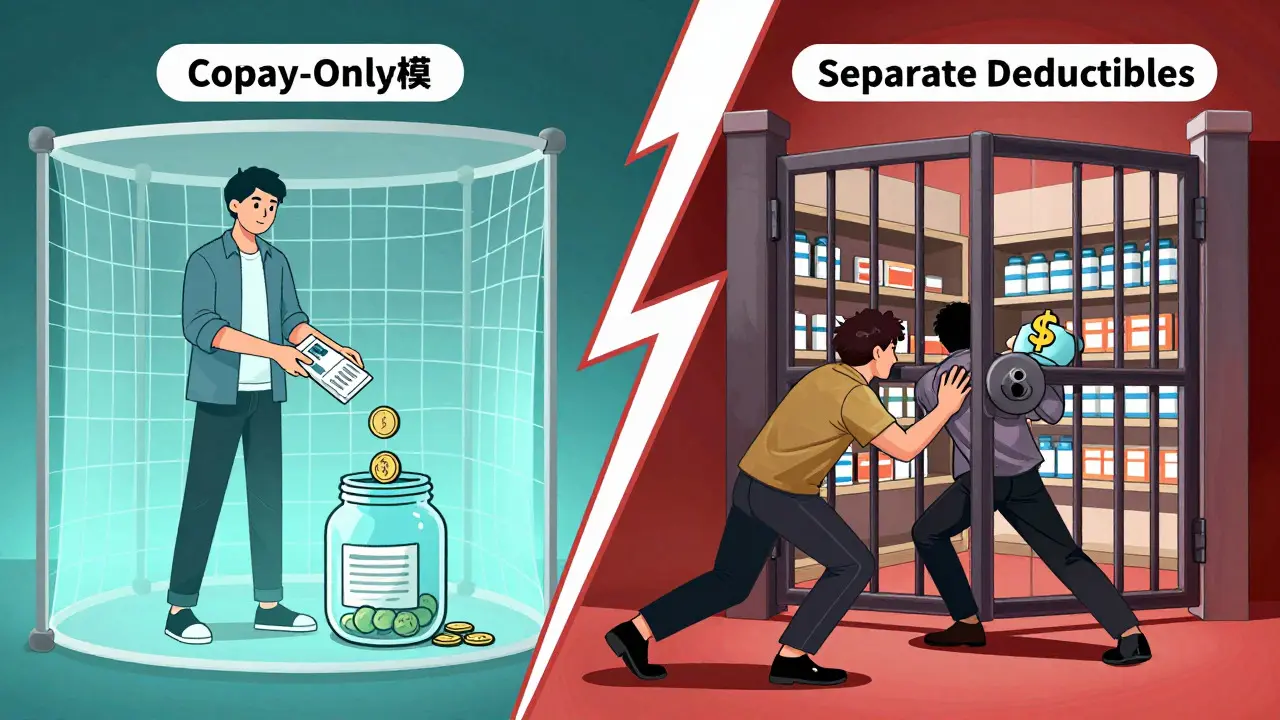
1. The Copay-Only Model (Most Common for Generics) In this structure, there is no specific prescription deductible. As soon as you fill a script, you pay a set amount (e.g., $10 for generics, $30 for brand-name). These payments happen immediately, even if you haven't seen a doctor yet. Because there is no prescription deductible to meet, the question "does it count toward the deductible?" is technically moot for prescriptions. However, these $10 payments absolutely count toward your overall out-of-pocket maximum. If you fill 100 generics a year, you've paid $1,000 toward your cap, but your medical deductible remains untouched.
2. Separate Medical and Prescription Deductibles This is the trickiest model. About 37% of employer-sponsored plans use this design. Here, you have a medical deductible (e.g., $1,500) and a separate, often lower, prescription deductible (e.g., $500). Until you pay $500 out of pocket for drugs, you pay the full cash price for every prescription. Once you hit that $500 mark, you switch to copays. Those subsequent copays count toward your out-of-pocket maximum but still do not reduce your $1,500 medical deductible. This creates a double burden for people who need both frequent doctor visits and medications.
3. Single Combined Deductible In this less common model (about 27% of plans), medical and prescription costs share one deductible. Usually, prescriptions don't have fixed copays here. Instead, once you meet the combined deductible, you pay a percentage (coinsurance) of the drug's cost. In this scenario, every dollar you spend on a prescription *does* count toward the deductible. This is often the most favorable structure for heavy medication users, though premiums may be slightly higher to account for the shared risk.
Why the Confusion Persists: The "Valley of Confusion"
Despite clear rules, most people get this wrong. A 2023 survey by America's Health Insurance Plans found that 68% of consumers incorrectly believe prescription copays count toward their deductible. Only 22% understood the correct mechanism. Why? Because the terminology is misleading. We use the word "cost-sharing" for everything, making it sound like all expenses are part of the same pool. They aren't.
Dr. Karen Pollitz, a senior fellow at the Kaiser Family Foundation, notes that while the ACA's requirement that copays count toward the out-of-pocket max was a vital protection, keeping deductibles separate created a persistent gap in consumer understanding. People see their bank account drain and assume their progress bar is filling up. It isn't. It's only filling up the safety net, not the threshold.
This misunderstanding has real financial consequences. According to industry data, approximately $15 billion in necessary medications go unused annually because patients avoid refills, thinking they are "saving up" for their deductible. In reality, for many, the deductible won't be met by prescriptions alone. Waiting can lead to worse health outcomes and higher emergency room costs later, which *do* count toward the deductible but at a much steeper price tag.
Real-World Scenarios: What This Means for Your Wallet
Let’s look at two specific examples to make this concrete.
Scenario A: The Chronic Condition Manager Maria has Type 2 diabetes. Her plan has a $2,000 medical deductible and a $10 generic copay. She fills her insulin and metformin monthly. Each month, she pays $20 ($10 + $10). Over a year, she pays $240 in copays.
- Deductible Status: Unchanged. She still owes $2,000 for other medical services.
- Out-of-Pocket Max Status: Reduced by $240. If her OOP max is $6,000, she now has $5,760 left to pay before hitting the cap.
- Takeaway: She gets predictable costs for meds, but her deductible remains a barrier for doctor visits.
Scenario B: The Accident Victim John breaks his leg in a fall. His plan has a $1,500 deductible and 20% coinsurance. He also needs painkillers, which have a $5 generic copay.
- Medical Costs: The surgery bill is $10,000. He pays the first $1,500 (deductible). The remaining $8,500 is split: he pays 20% ($1,700), insurer pays 80%.
- Medication Costs: He fills painkillers 4 times, paying $5 each = $20 total.
- Total Out-of-Pocket: $1,500 (deductible) + $1,700 (coinsurance) + $20 (copays) = $3,220.
- Key Insight: The $20 in copays counted toward his OOP max, but it didn't lower the $1,500 deductible he already paid. If he hadn't broken his leg, those $20 would have been the *only* thing counting toward his OOP max, leaving his deductible untouched.
How to Check Your Specific Plan Rules
Since plan structures vary, you cannot rely on general advice. You need to verify your specific contract. Here is how to find the truth in under five minutes:
- Find your Summary of Benefits and Coverage (SBC). This is a standardized document provided during open enrollment. Look for the column labeled "Prescriptions." It will explicitly state if there is a deductible for drugs and what the copay is.
- Check the Explanation of Benefits (EOB). After a claim is processed, your EOB shows exactly how the payment was applied. Look for lines itemized as "Member Responsibility - Copay" versus "Member Responsibility - Deductible." If you see a copay charge, it likely did not reduce your deductible balance.
- Contact Customer Service with a Script. Don't just ask "how does this work?" Ask: "If I pay my $10 generic copay today, will my current deductible balance decrease?" Get the agent's name and reference number. If they say yes, ask them to confirm in writing via email or portal message.
Pro Tip: If you are enrolled in a High-Deductible Health Plan (HDHP) paired with a Health Savings Account (HSA), the rules are stricter. Only qualified medical expenses count toward the HSA deduction. While copays are generally qualified, tracking them separately is crucial for tax reporting.

Future Changes: Will Copays Ever Count Toward Deductibles?
The landscape is shifting. In April 2024, the Department of Health and Human Services announced new guidelines mandating clearer communication about how prescription costs count toward deductibles and out-of-pocket maximums, effective for 2025 plan years. This follows a Government Accountability Office report showing that 41% of consumers were confused about prescription cost-sharing in 2023.
Furthermore, the Centers for Medicare & Medicaid Services (CMS) Innovation Center is testing "Integrated Deductible" models in five states. In these pilot programs, prescription costs-including copays-count toward a single, unified deductible. Preliminary results show a 28% increase in medication adherence among chronic disease patients because the financial penalty for taking meds is reduced.
Industry analysts predict that by 2027, 60% of major insurers will offer at least one plan design where generic prescription copays count toward the deductible. This shift is driven by consumer demand for simplicity. However, the American Hospital Association warns that eliminating the distinction could raise premiums by 3-5% annually. So, while the direction is toward simpler rules, expect a transition period where old and new plan designs coexist.
Frequently Asked Questions
Do brand-name copays count toward the deductible?
Generally, no. Like generic copays, brand-name copays typically count toward the out-of-pocket maximum but not the deductible, unless your plan uses a single combined deductible structure where coinsurance applies instead of fixed copays.
What happens if I hit my out-of-pocket maximum before the deductible?
It is possible, though rare, if you have a low out-of-pocket max and high-frequency copays (e.g., for chronic conditions). Once you hit the OOP max, insurance pays 100% of covered services, regardless of whether the deductible was fully met. This is the ultimate safety net.
Do preventive care costs count toward the deductible?
Under the ACA, most preventive services (like annual physicals and vaccinations) must be covered at 100% with no cost-sharing. Therefore, they do not count toward the deductible or the out-of-pocket maximum because you shouldn't be paying anything for them in the first place.
Does using an out-of-network pharmacy affect how copays count?
Usually, yes. Out-of-network costs often do not count toward the out-of-pocket maximum at all, depending on your plan type. If you go out-of-network, you may be subject to balance billing and lose the protection of the OOP cap. Always stay in-network to ensure your copays count toward your limits.
Can I choose a plan where copays count toward the deductible?
Yes, but options are limited. Look for plans advertised as having a "single deductible" or "integrated deductible." These are becoming more common due to CMS pilot programs. Compare the premium cost against the benefit of a lower effective deductible for heavy medication users.