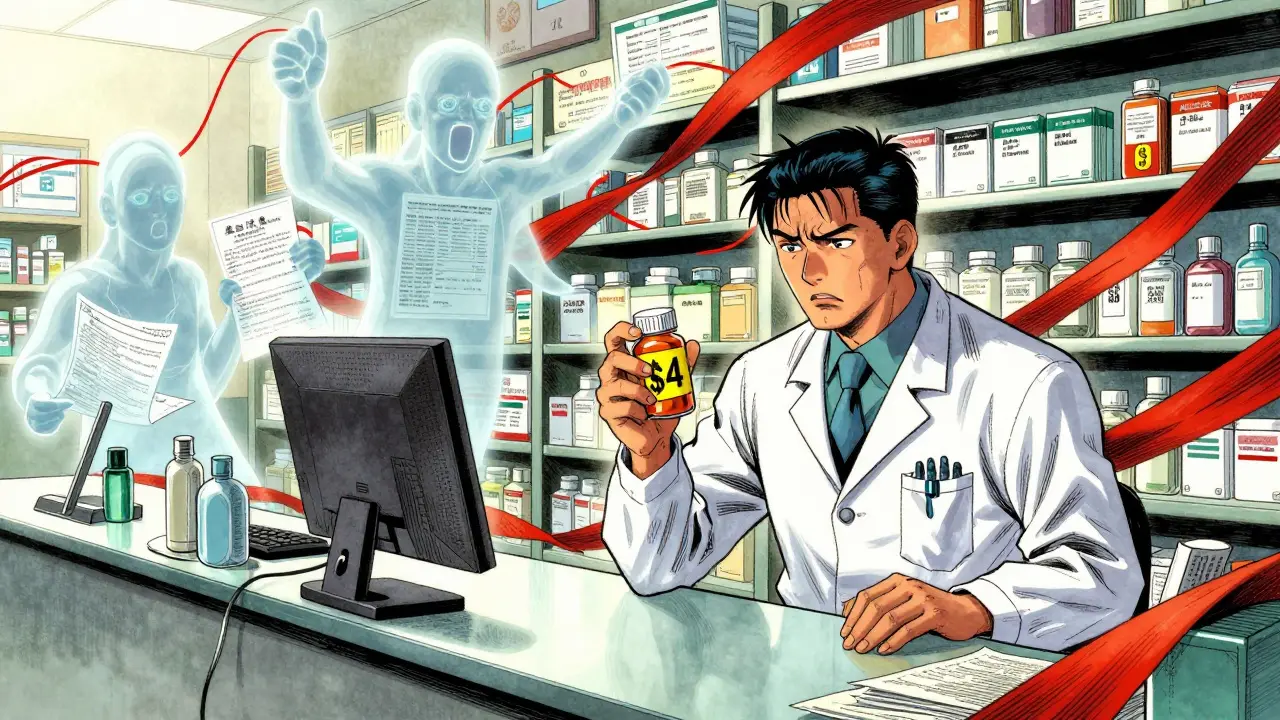
Walk into any pharmacy in the United States today, and you will likely see a sign advertising "$4 generics." It feels like a win for everyone. But behind that simple sticker price lies a tangled web of federal statutes, state regulations, and corporate contracts that determine who actually gets paid-and how much. The system isn't just about moving pills from shelf to patient; it is a high-stakes economic engine governed by laws dating back decades.
If you are a pharmacist, a patient, or a healthcare administrator, understanding these reimbursement models is no longer optional. With independent pharmacies reporting razor-thin margins and patients facing unpredictable out-of-pocket costs, the rules of the game have changed. This article breaks down how laws like the Hatch-Waxman Act and modern Medicaid rebate programs directly dictate the payment flow for generic drugs.
The Foundation: Hatch-Waxman and the Birth of Generics
To understand why generic drugs are reimbursed differently than brand-name medications, we have to look at the Hatch-Waxman Act, officially known as the Drug Price Competition and Patent Term Restoration Act of 1984. Before this law, generic drugs were virtually non-existent because manufacturers couldn't rely on patent protections, and brand-name companies had little incentive to share clinical data with competitors.
The Hatch-Waxman Act created a balanced ecosystem. It established the Abbreviated New Drug Application (ANDA) pathway, allowing generic manufacturers to prove their products were bioequivalent to brand-name drugs without repeating expensive clinical trials. In exchange, brand-name manufacturers received extended patent terms to compensate for time lost during FDA review. This legal framework is the bedrock of the current generic market, which now accounts for approximately 90% of all prescriptions filled in the US, yet only 23% of total drug spending.
This law didn't just create a product category; it created a reimbursement expectation. Because generics are cheaper to produce, payers-insurance companies, Medicare, and Medicaid-expect them to be reimbursed at lower rates. The law incentivized substitution, but it also set the stage for the complex pricing models we see today.
How Pharmacies Get Paid: AWP vs. MAC Pricing
When a pharmacy dispenses a medication, they don't get paid a flat fee. They are reimbursed based on formulas that attempt to estimate what the pharmacy paid for the drug, plus a dispensing fee to cover overhead. For generic drugs, two primary models dominate: Average Wholesale Price (AWP) minus a percentage, and Maximum Allowable Cost (MAC).
Average Wholesale Price (AWP) is a list price that rarely reflects the actual cost a pharmacy pays. Historically, insurers would reimburse pharmacies at AWP minus a certain percentage (e.g., AWP - 15%). However, because AWP is often inflated, this model can sometimes overpay or underpay depending on the specific discount the pharmacy negotiated with wholesalers.
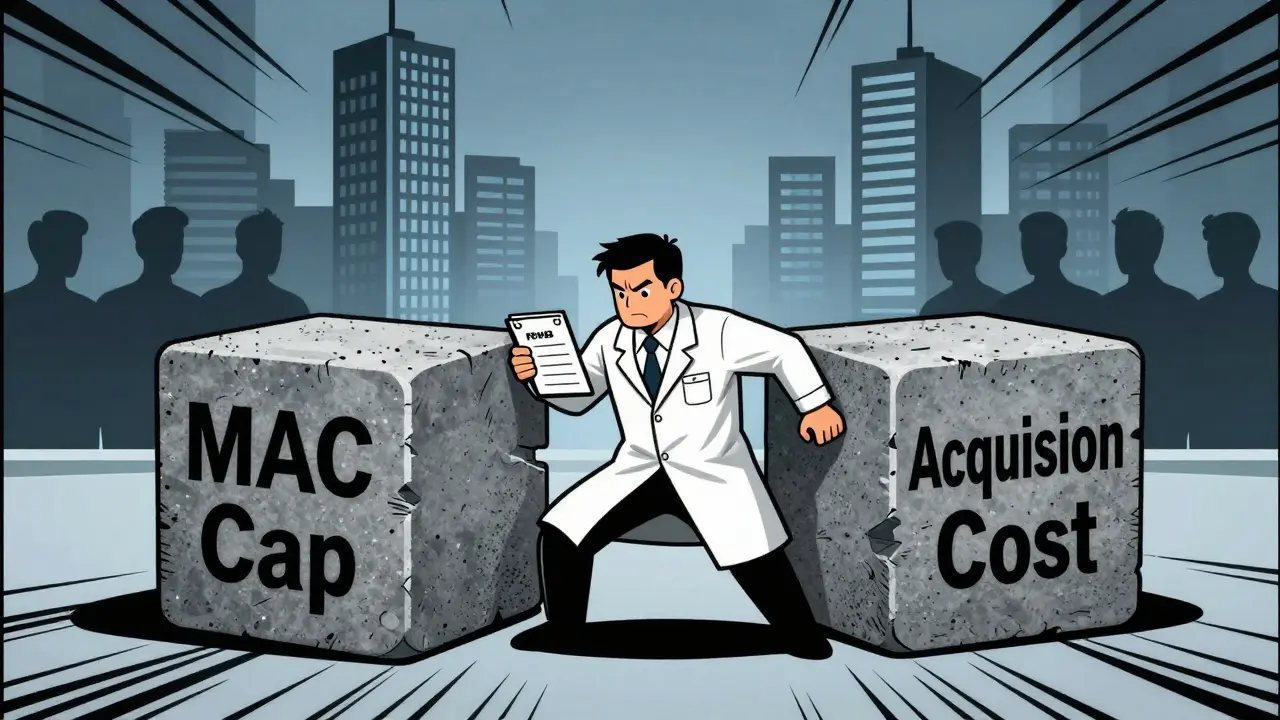
Maximum Allowable Cost (MAC) is more aggressive. Under MAC programs, particularly in Medicaid, insurers set a hard cap on what they will reimburse for a generic drug. If the pharmacy's acquisition cost is higher than the MAC rate, the pharmacy absorbs the loss. According to data from the National Community Pharmacists Association, average generic drug reimbursement margins for independent pharmacies dropped to just 1.4% in 2023, compared to 3.2% in 2018. Many pharmacists report losing money on every generic script filled under strict MAC pricing, forcing them to either refuse to stock certain generics or absorb the deficit to keep patients coming in.
| Model | Basis of Payment | Risk to Pharmacy | Typical Use Case |
|---|---|---|---|
| AWP Minus % | List price minus a fixed percentage | Low to Moderate | Commercial Insurance, Some Medicare Plans |
| MAC (Hard Cap) | Fixed maximum amount per unit | High (if acquisition cost > MAC) | Medicaid, Public Assistance Programs |
| Spread Pricing | Payer pays PBM more than PBM pays pharmacy | Moderate (hidden fees) | Self-Insured Employer Plans |
The Role of PBMs and Spread Pricing
You cannot discuss reimbursement without talking about Pharmacy Benefit Managers (PBMs). These intermediaries negotiate rebates with drug manufacturers and manage formularies for insurers. The big three-CVS Caremark, Express Scripts, and OptumRX-process over 80% of all prescription claims in the US.
A controversial practice in this space is spread pricing. Here’s how it works: An insurer might reimburse a PBM $10 for a generic drug. The PBM then pays the pharmacy $7. The PBM keeps the $3 difference as profit. While this was once common, transparency laws have begun to crack down on it. In 2018, "gag clauses"-contracts that prevented pharmacists from telling patients if paying cash would be cheaper than using insurance-were banned. Prior to the ban, consumer advocacy groups estimated that one in five prescriptions affected patients through these hidden spreads.
For generic drugs, PBMs also drive volume. They steer patients toward preferred generics on their formularies to maximize rebates from manufacturers. This creates a perverse incentive: sometimes, the cheapest generic for the patient isn't the one the PBM prefers, because the PBM is prioritizing its own rebate revenue over direct cost savings for the end-user.
Medicare Part D and the New $2 Generic List
Medicare Part D covers outpatient prescription drugs for over 50 million beneficiaries. Unlike Medicaid, which is jointly funded by states and the federal government, Part D is administered through private plans approved by CMS. These plans use tiered formularies, where generics typically sit on Tier 1 or 2, requiring lower copays than specialty drugs.
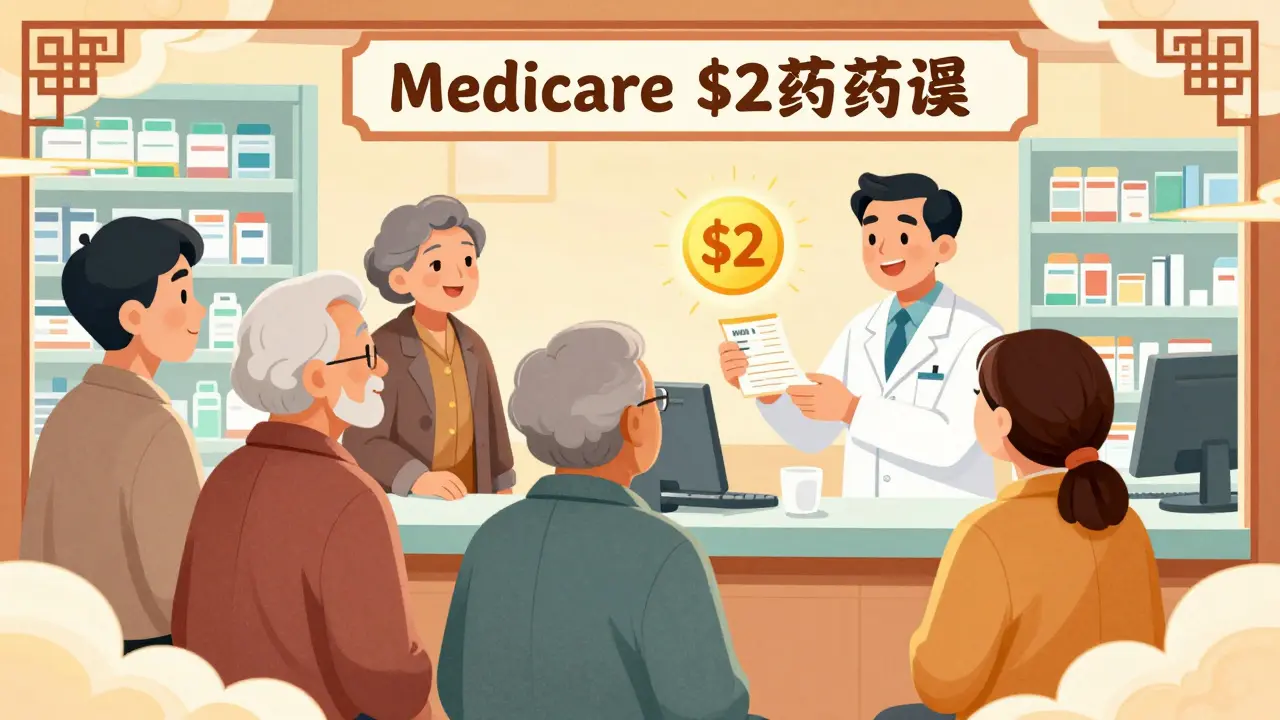
In 2025, CMS introduced a significant shift with the Medicare $2 Drug List Model. This voluntary model aims to simplify cost-sharing for low-cost, clinically important generic drugs. Instead of variable copays, participating plans would charge a flat $2 copay for a curated list of 100-150 generic drugs. The selection criteria include clinical importance, frequency of use, and potential for supply interruptions.
This move addresses a major pain point: unpredictability. Previously, a patient might face a $10 copay for one generic and $15 for another, depending on the plan's specific negotiations. The $2 model aligns with retail trends seen in grocery chain pharmacies, aiming to improve medication adherence by removing financial friction. However, it raises questions about sustainability. If the copay is capped at $2, how do pharmacies and PBMs recover their costs? The answer lies in increased volume and reduced administrative overhead, but early adopters are closely watching margin impacts.
State Laws and Medicaid Rebates
While federal laws set the broad strokes, state laws add layers of complexity. Each state manages its own Medicaid program, leading to 50 different sets of rules for generic reimbursement. Most states use Preferred Drug Lists (PDLs), updated annually by state Pharmacy and Therapeutics committees. Drugs on the PDL are preferred generics, often requiring prior authorization if a non-preferred alternative is prescribed.
The Medicaid Drug Rebate Program (MDRP) requires manufacturers to pay rebates to states and the federal government. These rebates are calculated based on the Average Manufacturer Price (AMP) and other metrics. The goal is to offset the cost of prescription drugs for Medicaid patients. However, critics argue that the rebate structure encourages manufacturers to raise list prices, knowing that higher lists lead to higher rebates, which ultimately benefit the government rather than the patient at the counter.
As of 2023, 44 states had enacted laws addressing pharmacy reimbursement practices, including requirements for fair appeal processes when a pharmacy disagrees with a MAC rate. These state-level interventions are crucial for independent pharmacies, which lack the bargaining power of large chains.
Challenges and Future Outlook
The current system faces several headwinds. First, authorized generics-where brand-name manufacturers release their own generic version-can stifle competition by limiting the number of true generic competitors entering the market. Second, supply chain disruptions mean that even when a generic is cheap, it might not be available, forcing patients onto more expensive alternatives.
Looking ahead, the Inflation Reduction Act of 2022 has introduced an annual out-of-pocket cap of $2,000 for Medicare Part D beneficiaries starting in 2025. This cap changes the dynamic for patients, reducing the fear of catastrophic drug costs. However, for pharmacies, the pressure remains. With generic prices continuing to compress at an estimated 5-7% annually through 2027, many experts predict further consolidation in the pharmacy sector, with smaller independents struggling to survive under current reimbursement models.
Value-based payment models may eventually replace fee-for-service structures, but such transitions are expected to take at least 5-7 years. Until then, the interplay between federal mandates, state regulations, and PBM contracts will continue to define how generic drugs are paid for-and who bears the cost.
What is the difference between AWP and MAC pricing for generic drugs?
AWP (Average Wholesale Price) is a list price used as a benchmark, with reimbursement calculated as AWP minus a percentage. MAC (Maximum Allowable Cost) is a hard cap set by insurers, meaning the pharmacy receives no more than the MAC amount regardless of what they paid for the drug. MAC pricing poses higher risk to pharmacies if their acquisition cost exceeds the cap.
How does the Hatch-Waxman Act affect generic drug reimbursement?
The Hatch-Waxman Act created the legal framework for generic drug approval via the ANDA pathway, establishing generics as a distinct, lower-cost category. This led to reimbursement models that differentiate between brand-name and generic drugs, encouraging substitution to reduce overall healthcare costs.
What is spread pricing in pharmacy reimbursement?
Spread pricing occurs when a PBM charges an insurer more for a drug than it reimburses the pharmacy. The PBM keeps the difference as profit. This practice lacks transparency and has been criticized for inflating costs for self-insured employers while squeezing pharmacy margins.
What is the Medicare $2 Drug List Model?
The Medicare $2 Drug List Model is a voluntary initiative by CMS that allows Part D plans to offer a flat $2 copay for a selected list of low-cost, clinically important generic drugs. It aims to simplify costs for patients and improve medication adherence.
Why are independent pharmacies struggling with generic reimbursement?
Independent pharmacies often face thin margins due to MAC pricing and lack of negotiating power with PBMs. With average generic reimbursement margins dropping to 1.4% in 2023, many struggle to cover operational costs, especially when acquisition prices exceed reimbursement caps.