The Core Difference Between Patents and Exclusivity
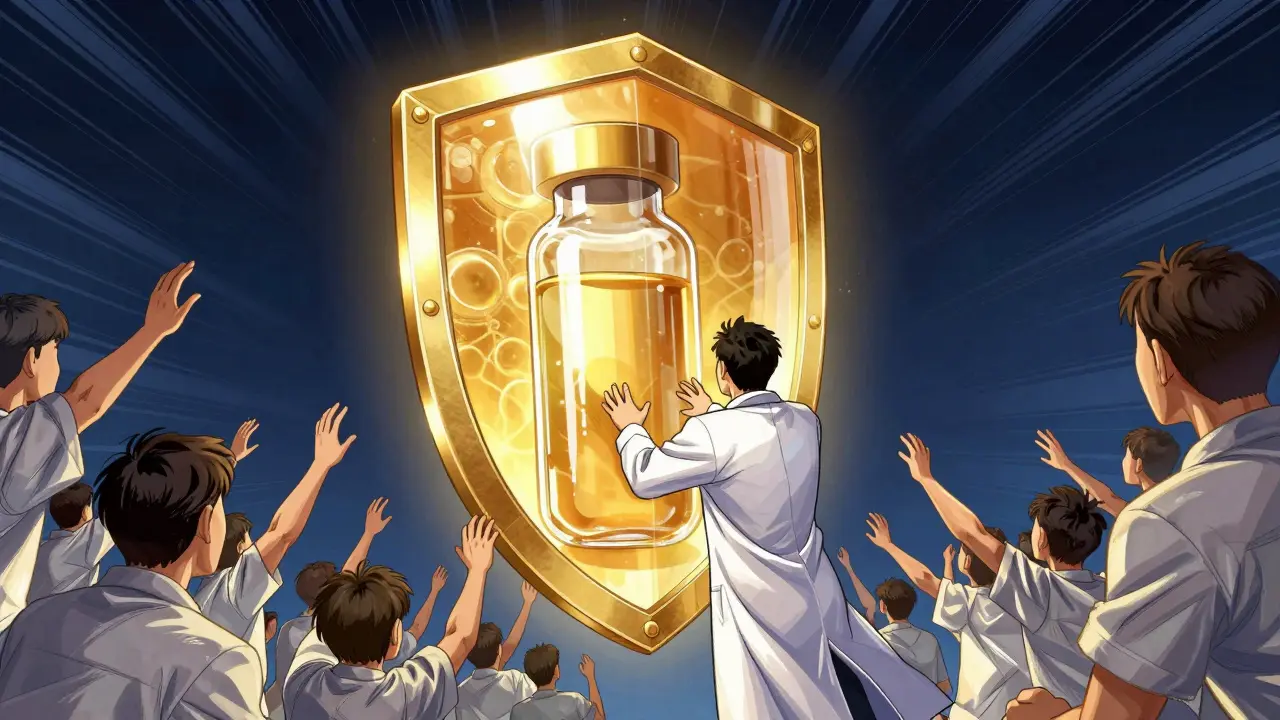
Most people assume patents are the only way to keep competitors off the market, but in the drug world, that's not the case. A patent protects an invention-like a specific chemical molecule-and you have to sue people in court to enforce it. Regulatory exclusivity is different. It is a right granted automatically by a regulatory body, such as the FDA (Food and Drug Administration), upon the approval of a drug application. Because the agency itself enforces the rule, the innovator doesn't need to spend millions on litigation to stop a generic from launching; the agency simply refuses to approve the competitor's application until the exclusivity window closes. This creates a much more predictable timeline for revenue. While patents start ticking from the moment you file the application (often years before the drug is even tested in humans), regulatory exclusivity only starts when the drug is actually approved for sale. This ensures that the clock doesn't run out while the drug is stuck in clinical trials.Common Types of Market Protection
Not all drugs get the same level of protection. The length of the "shield" depends on what the drug is and who it's for. In the US, the framework is largely shaped by the Hatch-Waxman Act and the Orphan Drug Act.- New Chemical Entities (NCE): If a company develops a completely new molecule, they typically get 5 years of protection. The FDA won't even accept a generic application for the first 4 years and won't approve one until the 5th year is up.
- Biologics: These are complex medicines made from living organisms. Because they are so hard to make, the BPCIA (Biologics Price Competition and Innovation Act) gives them a massive 12-year window of exclusivity.
- Orphan Drugs: These are medicines for rare diseases affecting fewer than 200,000 people in the US. To incentivize companies to treat tiny patient populations, the government grants 7 years of market protection.
- Clinical Investigation Exclusivity: Even for old drugs, if a company spends the money to prove a new use or a different dosage through new clinical trials, they can get a 3-year exclusivity period for that specific change to the label.

Global Variations in Protection
Different countries have different philosophies on how to balance innovation with affordability. While the US is known for longer protections, Europe and Asia handle it differently.| Region | Primary Rule | Typical Duration | Key Focus |
|---|---|---|---|
| United States | Statutory Protection | 5 to 12 Years | Incentivizing high-cost R&D |
| European Union | 8+2+1 Rule | Up to 11 Years | Data and Market exclusivity split |
| Japan | Data Exclusivity | 10 Years (NCE) | Protection of clinical trial data |
The Economic Impact and the "Patent Cliff"
From a business perspective, regulatory exclusivity is a goldmine. According to IQVIA data, drugs under active exclusivity can command prices over three times higher than their generic counterparts. This is why companies like AbbVie were able to maintain massive revenues for Humira long after its primary patents expired; the 12-year biologics exclusivity acted as a second line of defense. However, this creates a tension. On one side, drug developers argue that without these protections, they wouldn't risk billions on a drug that might fail. On the other side, patient advocacy groups argue that these protections are too long and keep life-saving meds overpriced. A 2020 FDA study showed that the average innovator enjoys about 12.3 years of combined protection, but for biologics, that number jumps to nearly 15 years. This effectively pushes back the "patent cliff"-the moment when a drug loses its monopoly and prices plummet.
Practical Implementation for Developers
Managing these timelines is a full-time job. Most major pharma firms now employ dedicated exclusivity managers because missing a deadline or failing to document a milestone can cost millions in lost revenue. If you're navigating this, you have to look beyond the legal team and work closely with regulatory affairs specialists. To qualify for these protections, documentation is everything. For instance, if you're aiming for orphan drug status, you must prove the disease affects fewer than 200,000 people at the exact time of approval. If your data is sloppy, the FDA will simply deny the exclusivity, leaving you vulnerable to any generic that can prove bioequivalence. Many firms use the FDA Purple Book to track the status of biological products and biosimilars, though it's primarily a US-centric tool.The Future of Market Protection
We are seeing a shift toward shorter exclusivity windows. In the EU, there are proposals to drop data exclusivity from 8 years down to 6 to get generics to patients faster. In the US, there is ongoing debate about reducing the biologics window from 12 years to 10. We are also seeing the rise of "irreproducible" therapies, like certain cell therapies. For these, regulatory exclusivity might actually be irrelevant. Why? Because the product is so complex and customized that a competitor can't just "copy" it. In those cases, the biological nature of the product provides more protection than any government rule ever could. As we move toward more personalized medicine, the traditional "one-size-fits-all" exclusivity clock may become less important than the actual technical difficulty of replicating the therapy.Can a drug have both a patent and regulatory exclusivity?
Yes, and most do. They usually run at the same time. If the patent expires first, the regulatory exclusivity keeps the market clear. If the exclusivity expires first, the patent can still be used to sue competitors who try to enter the market.
What happens when regulatory exclusivity expires?
The regulatory agency (like the FDA) can now approve Abbreviated New Drug Applications (ANDAs). This allows generic manufacturers to enter the market, typically leading to a sharp drop in the drug's price and a loss of market share for the original innovator.
Does regulatory exclusivity protect against all competitors?
No. It only prevents the approval of equivalent generic or biosimilar versions of the drug. It does not stop a competitor from developing a completely different molecule that treats the same condition.
Why do biologics get 12 years of protection while NCEs only get 5?
Biologics are far more expensive and complex to develop and manufacture than simple chemical pills. The longer window is intended to offset the higher risk and higher cost of bringing a biological drug to market.
How do you track when a drug's exclusivity ends?
In the US, the FDA's Orange Book (for small molecules) and Purple Book (for biologics) are the primary sources. These databases list the approved versions of the drug and their associated exclusivity dates.


Oh wow, so we just give billionaires a 12-year head start to bleed us dry because making "complex medicines" is just so hard for them. Truly a heartwarming system!