
Imagine buying a bottle of medication that looks identical to the brand-name version but loses its potency after just six months on the shelf. That is exactly what stability testing is designed to prevent. For generic drug manufacturers, this isn't just a quality control step; it is the make-or-break factor in getting approval from the U.S. Food and Drug Administration (FDA). If your stability data doesn't prove that your generic product remains safe, pure, and effective throughout its labeled shelf life, your application will be rejected.
The stakes are high. Stability-related issues account for roughly 35% of all Complete Response Letters (CRLs) issued by the FDA for generic drugs. This means one out of every three rejections stems directly from how you handle stability data. Understanding the specific requirements laid out in the Abbreviated New Drug Application (ANDA) guidance is not optional-it is the foundation of your regulatory strategy.
The Regulatory Foundation: Hatch-Waxman and ICH Guidelines
To understand where we are today, we have to look at the rules that built the modern generic industry. The Hatch-Waxman Act, passed in 1984, created the pathway for generic drugs to enter the market without repeating all the clinical trials done by the innovator company. However, it did not lower the bar for quality. Generic drugs must demonstrate bioequivalence and therapeutic equivalence to their Reference Listed Drug (RLD).
The technical backbone of these requirements comes from the International Council for Harmonisation (ICH). Specifically, the guideline Q1A(R2) dictates how stability testing should be conducted. While originally written for new molecular entities, the FDA has adapted these principles for generics through specific guidances, most notably the 2018 document titled "ANDAs: Stability Testing of Drug Substances and Products Questions and Answers." This document clarifies that while generics can leverage some historical data from the RLD, they cannot skip the rigorous testing required to prove their specific manufacturing process yields a stable product.
The core principle is simple: your generic drug must behave like the brand-name drug over time. If the brand lasts two years at room temperature, your generic must also last two years under the same conditions. Any deviation requires justification, and usually, that justification fails if the data isn't rock-solid.
Core Requirements for Stability Studies
When designing your stability study, the FDA expects precision. You aren't just throwing pills into a chamber and hoping for the best. Here is what the regulations demand:
- Batch Size and Scale: You must test at least three primary batches. These batches must be manufactured at a minimum pilot scale that meets current Good Manufacturing Practices (cGMP). A small lab-scale batch won't cut it because heat distribution and mixing dynamics change as you scale up production.
- Container Closure Systems: The packaging matters. Your stability testing must use the exact container closure system proposed for marketing. If you plan to sell the drug in high-density polyethylene bottles with child-resistant caps, that is what goes into the stability chamber. You cannot test in glass vials and assume the plastic bottle will perform the same way regarding moisture ingress or oxygen permeation.
- Testing Frequency: For products with a proposed shelf life of at least 12 months, the schedule is strict. You test every three months during the first year, every six months during the second year, and annually thereafter. Missing a time point can invalidate the entire study.
Additionally, you must test attributes that are likely to change during storage. This includes physical appearance, chemical purity, dissolution rate, and microbiological limits. If your drug contains preservatives, you must verify that antimicrobial efficacy remains intact. If it is a complex dose delivery system, functionality tests are required.
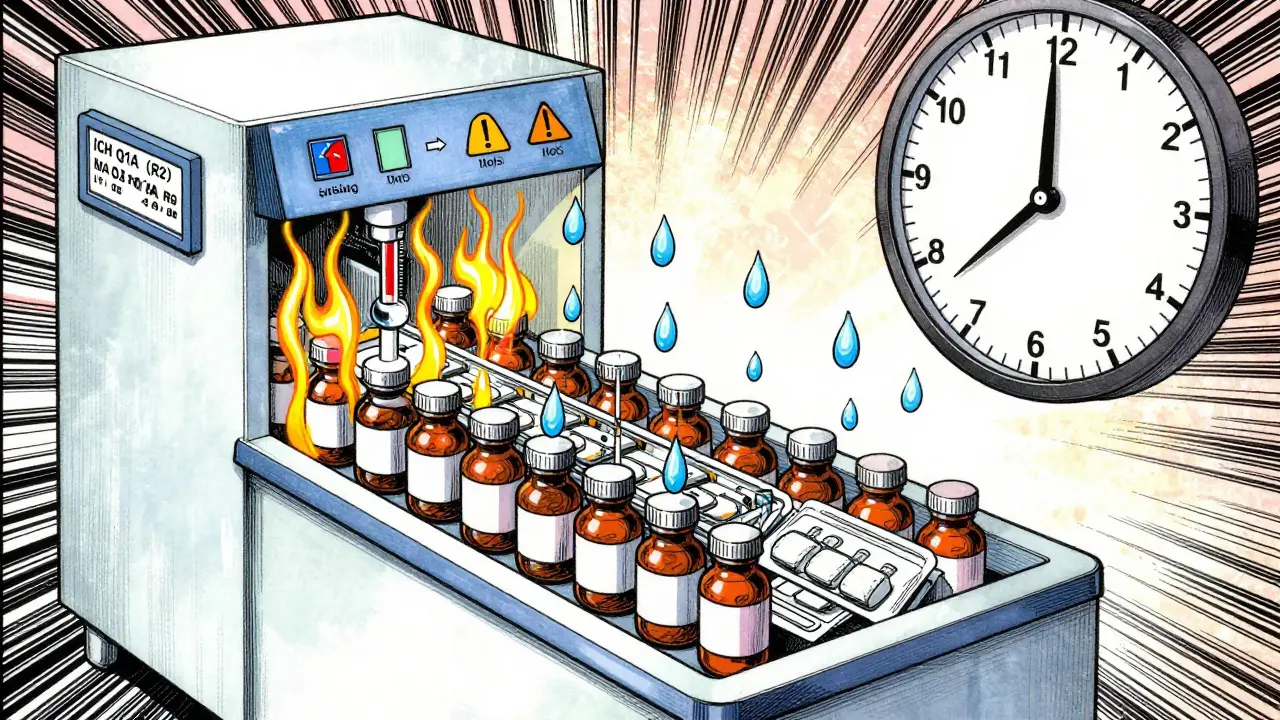
Accelerated vs. Long-Term Studies: What You Need to Submit
A common point of confusion for applicants is how much data to submit at different stages of the review process. The FDA distinguishes between Completeness Assessment and full scientific review.
For the initial Completeness Assessment, you need to show that you have started the studies. This typically means submitting a detailed stability protocol along with initial data and one additional time point for both accelerated and long-term studies. The accelerated condition is usually 40°C ± 2°C and 75% ± 5% relative humidity. The long-term condition matches your proposed storage label, often 25°C ± 2°C and 60% ± 5% relative humidity.
However, do not mistake this for the finish line. For the full scientific review, the FDA requires six months of accelerated data and six months of long-term data for pilot-scale batches. If you want to propose an expiration date based on accelerated data initially, you must commit to continuing real-time (long-term) studies to confirm that date. As Dr. John Jenkins, former Director of CDER's Office of New Drugs, noted, the expiration date must ultimately be supported by Real-Time stability studies. Accelerated data is a shortcut for labeling, not a substitute for proof.
| Submission Stage | Accelerated Conditions | Long-Term Conditions | Purpose |
|---|---|---|---|
| Completeness Assessment | Initial + 1 Time Point | Initial + 1 Time Point | Demonstrate study initiation and protocol adequacy |
| Full Scientific Review | 6 Months Minimum | 6 Months Minimum | Support tentative expiration dating and safety claims |
| Final Approval/Labeling | Ongoing until expiry | Ongoing until expiry | Confirm proposed shelf life and storage conditions |
Common Pitfalls Leading to Rejection
Why do so many applications fail? The data points to a few recurring errors. First, inadequate protocols are the biggest culprit. In 2020, nearly 98% of completeness assessment failures were linked to missing or vague stability protocols. You must reference specific USP chapters, such as USP <1151> Pharmaceutical Dosage Forms and USP <1010> Analytical Data, to show you know the standard methods.
Second, environmental control failures are rampant. FDA inspections in 2022 found that temperature deviations exceeding ±2°C accounted for nearly 20% of stability data invalidations. If your stability chamber spikes to 30°C when it should be at 25°C, that data point is suspect. Many manufacturers now use automated environmental monitoring systems to catch these excursions immediately. Without them, you are flying blind.
Third, insufficient method validation is a major issue. Over 30% of stability-related CRLs cite inadequate validation of stability-indicating methods. You must prove that your analytical method can detect degradation products specifically. If your HPLC method cannot separate the main peak from a degradation impurity, your purity results are meaningless.

Strategies for Compliance and Efficiency
Navigating these requirements doesn't have to be a guessing game. Successful manufacturers use a few key strategies to streamline the process.
Bracketing and Matrixing: If you have multiple strengths or package sizes, you don't necessarily need to test every single combination fully. Bracketing involves testing only the highest and lowest strength or size, assuming the intermediates fall within range. Matrixing tests a subset of samples at each time point. Both approaches require scientific justification and FDA approval, but they can significantly reduce costs and time. In 2022, about two-thirds of ANDAs that requested these designs received approval.
Pre-Submission Reviews: Engaging with the FDA before you submit can save months. Pre-study protocol reviews have been shown to reduce deficiency rates by over 40%. Use the FDA's questions and answers documents to self-assess your protocol. Ask yourself: Have I tested all critical quality attributes? Is my sampling plan robust enough?
Leverage RLD Data Wisely: While you must conduct your own studies, you can use the Reference Listed Drug's stability data to support your proposed storage conditions. If the RLD is stored at room temperature, and your early data shows similar behavior, you can argue against more stringent cold-chain requirements. However, never assume equivalence without data. Your formulation excipients might interact differently with moisture or light than the innovator's.
Future Trends: What’s Coming in 2026 and Beyond
The regulatory landscape is shifting. The FDA released a draft guidance in June 2025 proposing significant changes. One major shift is the move toward mandatory 24-month stability data for all new ANDAs, up from the current 12-month requirement for initial submission. This aims to provide greater assurance of long-term stability before approval.
Another trend is the integration of Quality by Design (QbD) principles. Instead of just testing for compliance, regulators want to see that you have understood the critical material and process attributes that affect stability. This proactive approach reduces variability and strengthens your application.
Technology is also playing a role. The FDA is exploring blockchain for stability data verification to ensure integrity and prevent tampering. Pilot programs began in mid-2025 across several manufacturing facilities. As a manufacturer, preparing your digital infrastructure for these traceability requirements will give you a competitive edge.
Finally, keep an eye on climate zone-specific requirements. The upcoming ICH Q1C(R2) revision will introduce stricter photostability testing and region-specific storage conditions. This affects nearly three-quarters of generic drug products. If you plan to export your generics globally, your stability program must be flexible enough to accommodate these diverse regional standards.
How many batches are required for generic stability testing?
The FDA requires stability studies on at least three primary batches of the drug product. These batches must be manufactured at a minimum pilot scale that complies with cGMP requirements. Testing fewer than three batches is generally not acceptable unless justified by specific statistical arguments and approved by the reviewer.
Can I use the brand-name drug's stability data for my generic application?
You cannot rely solely on the brand-name drug's data. You must conduct your own stability studies on your specific formulation and manufacturing process. However, you can reference the Reference Listed Drug's data to support proposed storage conditions and shelf-life claims, provided your own data demonstrates comparable performance.
What happens if my stability chamber temperature fluctuates?
Temperature fluctuations outside the allowed range (typically ±2°C) can invalidate your stability data. The FDA frequently cites inadequate chamber monitoring as a cause for rejection. It is crucial to use automated monitoring systems to record excursions and assess their impact on the product. Significant excursions may require restarting the study.
Is accelerated stability testing sufficient for final approval?
No. Accelerated testing can support initial labeling with a tentative expiration date, but final approval and long-term labeling require Real-Time (long-term) stability data. The FDA mandates that expiration dates be confirmed by ongoing long-term studies conducted at proposed storage conditions.
What are bracketing and matrixing in stability studies?
Bracketing and matrixing are design strategies used to reduce the number of samples tested. Bracketing involves testing only the extreme levels (e.g., highest and lowest strength) of certain factors. Matrixing tests a subset of samples at each time point. Both methods require scientific justification and must be outlined in your stability protocol submitted to the FDA.


i mean yeah but its not like they are just making it up as they go along. the guidelines are pretty strict about batch sizes and stuff. you cant just skip steps because you feel like it lol