
Antibiotics are one of the most important medical discoveries of the last century. Without them, even a simple cut or sore throat could turn deadly. But not all antibiotics are the same. They don’t just kill bacteria randomly-they target specific parts of the bacterial cell, like a lock and key. Understanding how they work helps you know why your doctor picks one over another, and why taking them wrong can make them useless.
How Antibiotics Actually Work
Antibiotics don’t work like painkillers or fever reducers. They don’t fix your body-they help your body fight off bacteria by attacking the bacteria directly. There are four main ways they do this: wrecking the cell wall, breaking the cell membrane, stopping protein production, and blocking DNA replication.
Think of a bacterium like a tiny factory. It needs walls to hold its shape, machines to build proteins, and blueprints to copy itself. Antibiotics target these systems. Some punch holes in the wall so the cell bursts. Others jam the protein-making machines. Some scramble the DNA code. Each class has a different strategy-and that’s why doctors choose specific ones for specific infections.
Beta-Lactams: The Cell Wall Destroyers
The most common group of antibiotics is called beta-lactams. This includes penicillin, amoxicillin, and the cephalosporins like cefalexin and ceftriaxone. These drugs mimic a part of the bacterial cell wall called D-alanyl-D-alanine. When the bacteria try to build their wall, they grab the antibiotic instead of the real building block. The result? A weak, broken wall that can’t hold up the pressure inside the cell. The bacteria swell and burst.
There are four generations of cephalosporins. First-gen ones like cefazolin are good for skin infections and simple staph. Second-gen, like cefuroxime, start to cover some Gram-negative bugs like E. coli. Third-gen drugs like ceftriaxone are used for serious infections like meningitis or severe pneumonia-they reach deeper into the body and fight tougher bacteria. Fourth-gen, like cefepime, are reserved for hospital-acquired infections, especially when other drugs have failed.
But here’s the catch: many bacteria make enzymes called beta-lactamases that chop up these antibiotics. That’s why amoxicillin alone often fails now. That’s why doctors combine it with clavulanic acid (as in Augmentin)-to block the enzyme and let the antibiotic work.
Protein Synthesis Blockers: Macrolides, Tetracyclines, and More
Another big group stops bacteria from making proteins. No proteins? No growth. No reproduction. Just stuck.
Macrolides like azithromycin and erythromycin bind to the 50S part of the bacterial ribosome. They’re often used for pneumonia, whooping cough, and some skin infections. Azithromycin is popular because you can take it for just 3-5 days. It also builds up in tissues, so it keeps working even after you stop taking it.
Tetracyclines, like doxycycline, bind to the 30S ribosome. They’re broad-spectrum, meaning they hit a wide range of bacteria-including unusual ones like chlamydia, Lyme disease, and acne-causing bugs. But they come with side effects: they make your skin super sensitive to sunlight, and they can permanently stain children’s teeth if taken before age 8.
Aminoglycosides like gentamicin are powerful but risky. They bind to the 30S ribosome too, but they cause mistakes in protein building. The bacteria make broken proteins and die. But they’re also toxic to the kidneys and ears. Doctors use them only in hospitals, often with close monitoring. And here’s a key detail: they need oxygen to get inside bacteria. That means they don’t work on anaerobic bugs-like the ones in deep abscesses or the gut.
Then there’s linezolid, a newer drug in the oxazolidinone class. It stops protein production at the very start-before the ribosome even assembles. It’s one of the few fully synthetic antibiotics, designed in a lab to beat resistant strains. It’s used for tough MRSA infections, especially when other drugs fail.
DNA Disruptors: Fluoroquinolones
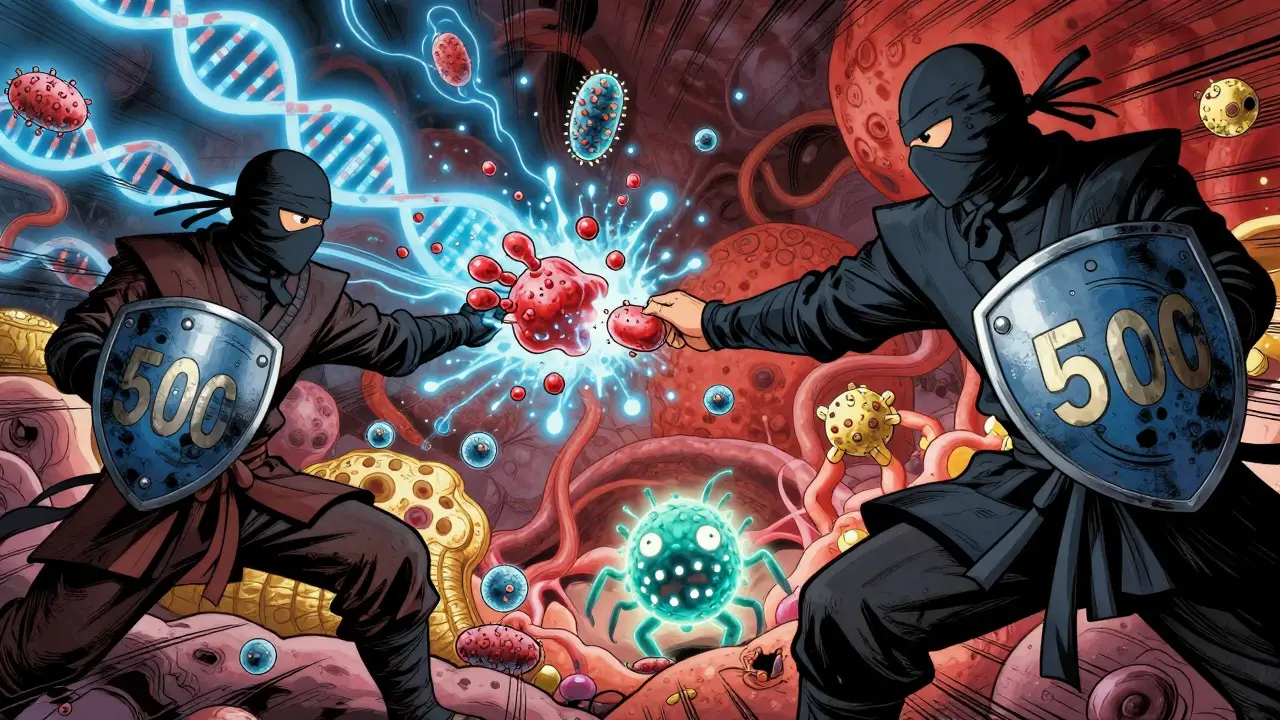
Fluoroquinolones like ciprofloxacin and levofloxacin go after bacterial DNA. They block two enzymes-DNA gyrase and topoisomerase IV-that unwind and copy DNA during cell division. No DNA copying? No bacterial babies.
These drugs are strong. They get into bones, lungs, and even inside cells. That’s why they’re used for urinary tract infections, some types of pneumonia, and even anthrax. But they come with serious warnings. The FDA added black box labels for tendon rupture and nerve damage. Some people report lasting pain, weakness, or tingling after just one dose. Because of this, they’re no longer first-line for simple infections like sinusitis or bronchitis.
And resistance? It’s everywhere. In many countries, over half of E. coli infections don’t respond to ciprofloxacin anymore. That’s why doctors now save these for when there’s no other choice.
Other Key Classes and Special Cases
Not all antibiotics fit neatly into the big four. Some have unique tricks.
Metronidazole is the go-to for anaerobic infections-like dental abscesses, C. diff colitis, and pelvic infections. It works by breaking down inside the bacteria and shredding their DNA. But if you drink alcohol while taking it, you get a nasty reaction: vomiting, flushing, fast heartbeat. About 60-70% of people feel it.
Sulfonamides, like sulfamethoxazole (often paired with trimethoprim as Bactrim), block folate production. Bacteria need folate to make DNA and proteins. Humans get folate from food, so this drug mostly hurts the bacteria. But resistance is high, so it’s mostly used now for specific infections like Pneumocystis pneumonia in people with weak immune systems.
Vancomycin is the last line against MRSA. It’s a glycopeptide that sticks to the cell wall like glue, blocking its assembly. It’s given through an IV and can damage kidneys. It’s not used lightly-but when a patient has a life-threatening MRSA infection, it’s often the only thing that works.
Why Antibiotics Fail: Resistance and Misuse
Antibiotics aren’t magic bullets. They’re tools-and like any tool, misuse breaks them.
Up to 30% of antibiotic prescriptions in outpatient settings are unnecessary. That’s because doctors can’t always tell if an infection is viral or bacterial. A sore throat? Could be strep. Could be a cold. A cough? Could be bronchitis (usually viral). But patients expect a pill. So sometimes, antibiotics get given anyway.
Every time you take an antibiotic when you don’t need it, you’re helping resistant bacteria survive. Those bacteria multiply. They pass on their resistance genes. Soon, the drug doesn’t work for anyone.
Resistance isn’t just a future problem. It’s here. The WHO lists antibiotic resistance as one of the top 10 global health threats. In some places, common antibiotics like amoxicillin or ciprofloxacin work less than half the time.
Even the right use can cause harm. Broad-spectrum antibiotics wipe out good bacteria in your gut. That can lead to C. diff infections-severe diarrhea that can be fatal. Studies show people on broad-spectrum antibiotics are 17 times more likely to get C. diff than those on narrow-spectrum ones.
What’s Next? New Drugs and Better Choices
There’s hope, but not much.
Only 42 new antibiotics are in development worldwide. Just 16 target the WHO’s priority superbugs. Most pharmaceutical companies don’t invest heavily because antibiotics don’t make money like cancer drugs. A new antibiotic might bring in $17 million a year-but cost over $1.5 billion to develop.
Some new drugs are coming. Cefiderocol, approved in 2019, tricks bacteria into sucking it in by pretending to be iron. It’s working against some of the toughest carbapenem-resistant infections. Phage therapy-using viruses that kill bacteria-is in late-stage trials. The European Medicines Agency has already set up rules to speed up approval.
And then there’s the UK’s ‘Netflix model.’ Instead of paying per pill, the government pays a flat fee for access to a new antibiotic. That way, the drug stays in reserve, used only when needed, and the company still gets paid. It’s a radical idea-and it might be the only way to save the next generation of antibiotics.
What You Can Do
You don’t need to be a doctor to help fight resistance.
- Only take antibiotics when a doctor confirms it’s a bacterial infection.
- Never use leftover antibiotics from a past illness.
- Finish the full course-even if you feel better.
- Don’t pressure your doctor for a prescription if they say no.
- Wash your hands. Vaccinate yourself. Prevent infections before they start.
Antibiotics saved millions. But they’re not infinite. The next time you’re prescribed one, ask: Is this really needed? Your answer could help keep these drugs working-for you, and for everyone else.
Can antibiotics treat viral infections like the flu or colds?
No. Antibiotics only work against bacteria. Colds, flu, most sore throats, and bronchitis are caused by viruses. Taking antibiotics for these doesn’t help and only increases the risk of side effects and antibiotic resistance. The CDC estimates that 30% of outpatient antibiotic prescriptions in the U.S. are unnecessary, mostly for viral infections.
Why do some antibiotics cause diarrhea?
Antibiotics kill both harmful and helpful bacteria in your gut. When good bacteria are wiped out, harmful ones like Clostridioides difficile (C. diff) can overgrow. This causes severe diarrhea, cramping, and sometimes life-threatening colitis. Broad-spectrum antibiotics are more likely to cause this because they destroy a wider range of bacteria. Narrow-spectrum antibiotics carry less risk.
Are natural remedies like honey or garlic as effective as antibiotics?
Some natural substances, like honey, have mild antibacterial properties and can help with minor skin wounds or sore throats. But they cannot replace antibiotics for serious infections like pneumonia, sepsis, or meningitis. There’s no scientific evidence that garlic, echinacea, or other supplements can cure bacterial infections. Relying on them instead of proven antibiotics can delay treatment and lead to complications.
Why can’t we just make new antibiotics faster?
Developing a new antibiotic takes 10-15 years and costs over $1.5 billion. Most pharmaceutical companies avoid it because antibiotics are used for short periods, unlike drugs for chronic conditions like high blood pressure or diabetes. Even if a new antibiotic works, doctors are trained to use it only as a last resort to prevent resistance-so sales are low. Return on investment is under 5%, compared to 15-20% for cancer drugs. Without new payment models like the UK’s ‘Netflix model,’ companies have little incentive to invest.
What’s the difference between bactericidal and bacteriostatic antibiotics?
Bactericidal antibiotics kill bacteria directly-like penicillin and ciprofloxacin. Bacteriostatic ones stop bacteria from multiplying, letting your immune system clear the rest-like tetracycline and azithromycin. In most cases, both work well. But for patients with weak immune systems (like those with cancer or HIV), bactericidal drugs are preferred because their bodies can’t fight off the infection on their own.
Can I stop taking antibiotics if I feel better?
No. Even if you feel fine, some bacteria may still be alive. Stopping early gives the strongest, most resistant ones a chance to survive and multiply. This is how antibiotic resistance spreads. Always finish the full course unless your doctor tells you otherwise. The length of treatment depends on the infection-some need 5 days, others 14 or more.
Antibiotics are powerful-but they’re not a quick fix. Their value lies in how carefully we use them. The next time you’re handed a prescription, remember: you’re not just treating an infection. You’re helping protect the future of medicine.


Antibiotics are amazing but so misunderstood. I used to think they were just strong medicine for anything that felt sick. Now I know they’re like precision tools - use the wrong one, and you’re just helping superbugs win. Thanks for laying this out so clearly.