
PPI & Clopidogrel Interaction Checker
Imagine taking a life-saving heart medication that stops your blood from clotting, only to unknowingly take another pill that cancels out its effects. This is the reality for many patients prescribed Clopidogrel, also known as Plavix, alongside proton pump inhibitors (PPIs) to protect their stomachs. The combination of these two common drugs creates a pharmacokinetic clash that can reduce the activation of clopidogrel, potentially leaving you vulnerable to heart attacks or strokes. While doctors prescribe PPIs to prevent dangerous gastrointestinal bleeding caused by antiplatelet therapy, certain types of PPIs interfere with the body’s ability to convert clopidogrel into its active form.
This isn't just theoretical chemistry; it's a clinical dilemma that has divided experts for over a decade. On one side, you have the risk of a stomach bleed, which increases by approximately 50% when you combine aspirin and clopidogrel. On the other side, you have the risk of a cardiovascular event if the clopidogrel doesn't work properly. Understanding this balance is crucial for anyone managing cardiovascular disease while dealing with acid reflux or ulcer history.
The Mechanism: How PPIs Block Clopidogrel Activation
To understand why this interaction happens, we need to look at how your liver processes these medications. Clopidogrel is what scientists call a "pro-drug." This means it is inactive when you swallow it. Your liver must use specific enzymes to chop it up and turn it into an active metabolite that actually prevents platelets from sticking together. The primary enzyme responsible for this critical step is Cytochrome P450 2C19 (CYP2C19).
Here is where the conflict arises. Proton pump inhibitors are also metabolized by CYP2C19. When you take both drugs, they compete for the same enzyme. Think of it like two cars trying to enter a single-lane tunnel at the same time. If the PPI gets in first, it blocks the clopidogrel from being processed. Studies show that high-dose omeprazole can reduce the maximum plasma levels of clopidogrel's active metabolite by nearly 50%. Even standard doses can cut those levels by about 32%. Without enough active metabolite, your blood remains too prone to clotting, defeating the purpose of the heart medication.
This mechanism is particularly dangerous for people who already have genetic variations in their CYP2C19 genes. Approximately 30% of the population carries loss-of-function polymorphisms, meaning their bodies are naturally slower at activating clopidogrel. Adding a PPI on top of this genetic disadvantage significantly raises the risk of major adverse cardiovascular events.
Not All PPIs Are Created Equal
The good news is that not all proton pump inhibitors interact with clopidogrel to the same degree. The strength of the inhibition depends on how tightly each PPI binds to the CYP2C19 enzyme. This distinction is vital because it allows doctors to choose a safer alternative without abandoning stomach protection entirely.
| PPI Medication | Interaction Risk | Effect on Active Metabolite | Clinical Recommendation |
|---|---|---|---|
| Omeprazole | High | Reduces levels by ~32-49% | Avoid concomitant use |
| Esomeprazole | High | Similar to Omeprazole | Avoid concomitant use |
| Lansoprazole | Moderate | Moderate inhibition | Use with caution |
| Rabeprazole | Low-Moderate | Reduces max levels by ~28% | Acceptable alternative |
| Pantoprazole | Low | Minimal effect (~14% decrease) | Preferred choice |
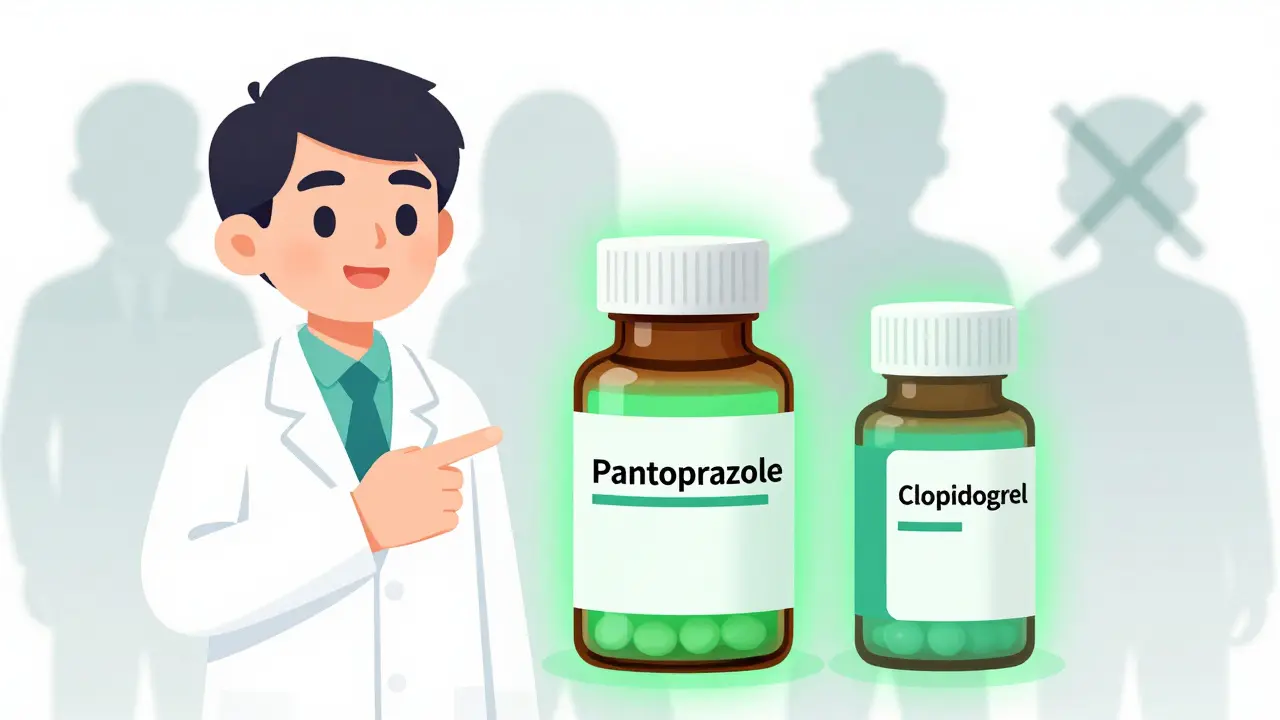
Omeprazole and esomeprazole are the worst offenders. They bind strongly to CYP2C19, creating significant competitive inhibition. In contrast, Pantoprazole has a much weaker affinity for this enzyme. Clinical trials, such as the COGENT trial published in the New England Journal of Medicine, showed that pantoprazole did not significantly increase cardiovascular events when taken with clopidogrel. Similarly, Dexlansoprazole is often recommended as a safe alternative because it undergoes different metabolic pathways. If you are currently taking omeprazole and clopidogrel, switching to pantoprazole might be a simple yet powerful adjustment to make with your doctor.

Clinical Guidelines and Expert Consensus
The medical community has spent years debating whether this chemical interaction translates to real-world harm. Early studies raised alarms, leading the FDA to issue a black box warning in 2014 advising against the concurrent use of omeprazole and clopidogrel. However, subsequent large-scale trials provided more nuanced data.
The 2023 guidelines from the American College of Cardiology (ACC) and the American Heart Association (AHA) reflect this evolution. They acknowledge the interaction but emphasize individualized risk assessment. The guidelines suggest that if a patient needs a PPI, clinicians should prefer pantoprazole or dexlansoprazole over omeprazole. The European Society of Cardiology takes a stricter stance, explicitly recommending the avoidance of omeprazole and esomeprazole with clopidogrel.
Why the difference in opinion? Some experts argue that the reduction in antiplatelet effect is modest and rarely causes stent thrombosis in practice. Others point to cases where the combination led to catastrophic outcomes, especially in patients with recent stents. The consensus today leans toward caution: don't stop the PPI if you need it for GI protection, but do switch to a non-interacting agent whenever possible.
Practical Strategies for Patients
If you are prescribed both clopidogrel and a PPI, here are concrete steps you can take to manage your health safely:
- Review your medication list: Check if you are taking omeprazole (Prilosec) or esomeprazole (Nexium). If so, ask your doctor about switching to pantoprazole (Protonix) or rabeprazole (Aciphex).
- Assess your GI risk: Not everyone on clopidogrel needs a PPI. You are at higher risk for gastrointestinal bleeding if you are over 65, have a history of ulcers, are infected with H. pylori, or are taking anticoagulants like warfarin. The American College of Gastroenterology recommends PPIs for patients with two or more of these risk factors.
- Consider timing: If switching medications is not an option, some pharmacists suggest staggering the doses. Taking the PPI in the morning and clopidogrel in the evening may reduce the direct competition for enzymes, though this is less effective than choosing a non-interacting PPI.
- Ask about genetic testing: For high-risk patients, CYP2C19 genotyping can determine if you are a poor metabolizer. While not routine for everyone, it provides clarity for those with recurrent cardiovascular events despite medication adherence.
- Explore alternatives: In some cases, doctors may switch from clopidogrel to Ticagrelor (Brilinta). Ticagrelor does not require metabolic activation by CYP2C19, so it avoids this specific interaction entirely. However, it is more expensive and has different side effect profiles, such as shortness of breath.
Real-World Impact and Future Directions
Despite clear guidelines, the problem persists. A 2023 analysis found that over 30% of Medicare beneficiaries still receive interacting PPI-clopidogrel combinations. This gap between knowledge and practice highlights the complexity of healthcare systems and patient inertia. Many patients continue taking generic omeprazole because it is cheap and familiar, unaware of the potential risk.
The economic impact is also notable. Pantoprazole costs slightly more than generic omeprazole, adding roughly $147 annually per patient in some reimbursement models. However, the cost of treating a stent thrombosis or a severe GI bleed far outweighs this difference. Healthcare providers are increasingly recognizing that optimizing drug interactions saves money in the long run by preventing hospitalizations.
Looking ahead, the development of new antiplatelet agents that bypass CYP2C19 metabolism offers hope. Drugs like ticagrelor and prasugrel are becoming more accessible, providing robust alternatives for patients who cannot tolerate clopidogrel or who have high GI risks. Yet, clopidogrel remains a cornerstone of therapy due to its low cost and established safety profile, ensuring that understanding its interactions with PPIs will remain relevant for years to come.
Can I take omeprazole with clopidogrel?
It is generally advised to avoid taking omeprazole with clopidogrel. Omeprazole strongly inhibits the CYP2C19 enzyme, which reduces the activation of clopidogrel and may lower its effectiveness in preventing heart attacks and strokes. Doctors usually recommend switching to pantoprazole or dexlansoprazole instead.
Which PPI is safest to take with clopidogrel?
Pantoprazole is considered the safest proton pump inhibitor to take with clopidogrel. It has minimal interaction with the CYP2C19 enzyme and has been shown in clinical trials not to significantly increase cardiovascular risks. Dexlansoprazole and rabeprazole are also acceptable alternatives.
Does pantoprazole affect clopidogrel effectiveness?
Pantoprazole has a very weak effect on clopidogrel activation. Studies show it may reduce exposure to the active metabolite by only about 14%, which is not considered clinically significant. Major guidelines recommend pantoprazole as the preferred PPI for patients on clopidogrel.
Why do doctors prescribe PPIs with clopidogrel?
Doctors prescribe PPIs to protect the stomach lining. Clopidogrel, especially when combined with aspirin, increases the risk of gastrointestinal bleeding and ulcers. PPIs reduce stomach acid production, lowering the risk of these serious complications by up to 50%.
What should I do if I am already taking omeprazole and clopidogrel?
Do not stop either medication abruptly. Contact your healthcare provider to discuss switching your PPI to a non-interacting option like pantoprazole. Your doctor will evaluate your specific risk factors for both cardiovascular events and gastrointestinal bleeding to make the best recommendation.
Is genetic testing necessary for clopidogrel users?
Genetic testing for CYP2C19 polymorphisms is not routinely required for everyone. However, it may be beneficial for high-risk patients, such as those with a history of stent thrombosis or recurrent cardiovascular events despite medication adherence. It helps identify individuals who are poor metabolizers of clopidogrel.
Can I stagger my doses to avoid the interaction?
Staggering doses, such as taking the PPI in the morning and clopidogrel at night, may slightly reduce the interaction but is not as effective as switching to a non-interacting PPI. Current guidelines prefer changing the medication rather than relying on timing adjustments.
Are there alternatives to clopidogrel that don't interact with PPIs?
Yes, ticagrelor and prasugrel are alternative antiplatelet drugs that do not rely on CYP2C19 for activation. Therefore, they do not have the same interaction issues with PPIs. However, they may have different side effects and are often more expensive than clopidogrel.