
Stopping SSRIs or SNRIs isn’t as simple as taking your last pill and calling it done. Many people assume that once they feel better, the medication can be tossed aside. But for a lot of patients, the real challenge begins when they try to quit. Withdrawal symptoms aren’t a sign of weakness or failure-they’re a biological response. And they can hit hard, fast, and in ways that feel completely unrelated to depression.
Why Withdrawal Happens at All
Your brain adapts to antidepressants. When you take an SSRI like sertraline or an SNRI like venlafaxine, your body adjusts how it produces, releases, and reabsorbs serotonin and norepinephrine. After weeks or months, your brain gets used to this new balance. When you suddenly remove the drug, that balance collapses. The receptors are still expecting the same level of stimulation, but now there’s nothing to meet that demand. That’s when symptoms start.This isn’t addiction. You’re not craving the drug for a high. But your nervous system is in shock. And that shock shows up in your body-often before you even realize you’ve stopped too quickly.
When Do Symptoms Start? It Depends on the Drug
Not all antidepressants are created equal when it comes to withdrawal. The half-life of the drug-how long it takes for half of it to leave your system-determines how soon symptoms appear.Take paroxetine (Paxil). With a half-life of just 24 hours, symptoms can hit within 1 to 3 days after your last dose. The same goes for sertraline (Zoloft) and venlafaxine (Effexor). Venlafaxine, in particular, is notorious. Nearly 65% of people who stop it abruptly report severe symptoms like dizziness, nausea, and those dreaded "brain zaps"-sudden, brief electric shock-like sensations in the head.
On the other end, fluoxetine (Prozac) has a half-life of 4 to 6 days. That means it lingers in your system longer. Symptoms might not show up for weeks. Some patients don’t notice anything until a month after stopping. That’s why you need to monitor yourself for up to three months if you’ve been on fluoxetine. What feels like a relapse might actually be delayed withdrawal.
SNRIs like duloxetine (Cymbalta) and desvenlafaxine (Pristiq) have 12-hour half-lives. That’s short. Symptoms usually appear within 1 to 3 days. And they tend to be more intense than with SSRIs.
How Long Do Symptoms Last?
Most people expect withdrawal to last a week or two. That’s what many doctors say. But real-world data tells a different story.According to the American Addiction Centers, 80% of withdrawal symptoms resolve within 1 to 2 weeks. Sounds reassuring, right? But here’s the catch: 10 to 20% of patients experience symptoms that drag on for months. Some report brain fog, insomnia, anxiety, or tingling in their limbs for over a year.
Online communities like Reddit’s r/antidepressants have over 15,000 posts from people describing withdrawal lasting longer than clinical guidelines suggest. One user, u/AnxiousAfterPaxil, shared that even after a 6-month taper, symptoms lasted 11 months. A 2019 Lancet Psychiatry study found that nearly half of people trying to quit needed more than six months to do it safely.
Why the gap? Because clinical trials often measure withdrawal in controlled settings with short tapers. Real life is messier. People stop cold turkey. They switch generics. They run out of pills. And no one warns them how long it might take to feel normal again.
What Symptoms Should You Watch For?
Withdrawal symptoms vary, but they usually fall into a few common categories:- Neurological: Brain zaps, dizziness, headaches, tingling, tremors
- Gastrointestinal: Nausea, vomiting, diarrhea, loss of appetite
- Psychological: Anxiety, irritability, mood swings, panic attacks, vivid dreams
- Physical: Fatigue, flu-like symptoms, sweating, insomnia
Brain zaps are one of the most distinctive signs. They’re not dangerous, but they’re startling. They feel like a quick zap or flicker in your brain, often triggered by eye movement. They’re more common with short-half-life drugs like paroxetine and venlafaxine.
Severe anxiety and suicidal thoughts are rare but serious. The FDA’s adverse event database shows that 4.2% of people discontinuing antidepressants report suicidal ideation. If this happens, don’t wait. Contact your provider immediately.
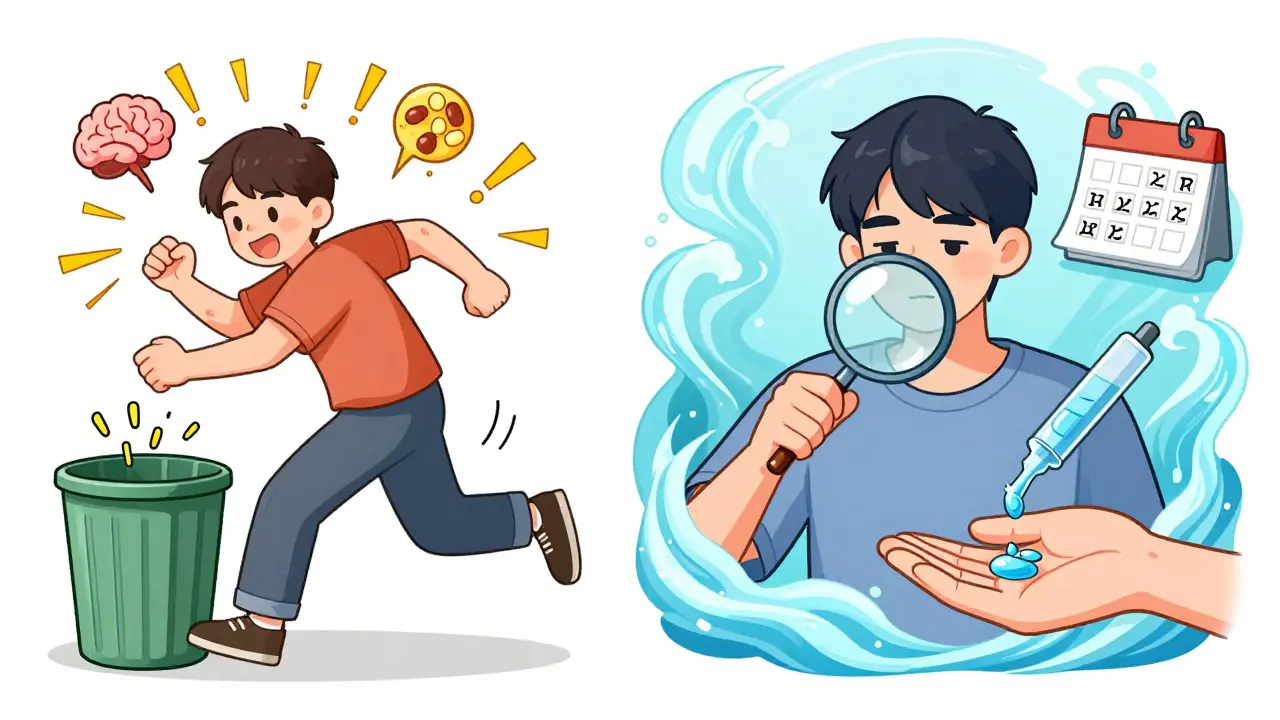
The Tapering Debate: Fast vs. Slow
Here’s where things get messy. There’s no universal agreement on how to taper.Some guidelines-like those from the British Association of Psychopharmacology-say a 2- to 4-week taper is fine. Others, like Outro.com’s 2023 evidence-based guide, recommend 6 to 12 months. Why such a big difference?
Short tapers are easier for doctors to manage. They fit into 15-minute appointments. But they’re not always safe. A 2023 British Medical Journal study found that 68% of people who tapered in less than 8 weeks had relapse or severe withdrawal. Only 22% did when they took over 20 weeks.
So what’s the best approach? The emerging consensus is this: taper slowly, listen to your body, and don’t rush.
The "10% Rule"-reducing your dose by 10% every 4 to 8 weeks-is gaining traction. It’s not about hitting a calendar date. It’s about how you feel. If you start getting dizzy or anxious after a reduction, pause. Stay at that dose until you stabilize. Then try again.
Some people benefit from switching to fluoxetine before tapering. Because it lasts so long in the body, it acts like a buffer. Others use liquid formulations to make tiny cuts-1% or 2% reductions at a time. A 2023 University of Toronto pilot study showed this reduced severe symptoms by 63%.
What to Do If Symptoms Hit
If you’re tapering and symptoms appear:- Don’t panic. Most symptoms are temporary.
- Hold your current dose. Don’t keep reducing.
- Wait 1 to 2 weeks. Often, symptoms fade on their own.
- If they don’t improve, go back to your last stable dose.
- Then taper even slower next time.
Restarting your original dose-even for a few days-can reset your nervous system. Symptoms usually resolve within 24 to 72 hours. This isn’t failure. It’s smart self-care.
Red Flags: When to Call Your Doctor
Most withdrawal symptoms are uncomfortable but not dangerous. But some need immediate attention:- Thoughts of self-harm or suicide
- Severe panic attacks or psychosis
- Seizures
- High fever or extreme confusion
These are rare, but they happen. If you’re unsure, err on the side of caution. Call your prescriber or go to urgent care.
Why Many Doctors Get This Wrong
A 2022 JAMA Internal Medicine study looked at over 2,400 primary care doctors. Only 31% followed recommended tapering guidelines. Over half recommended tapers under 4 weeks.Why? Time. Training. Lack of awareness. Many doctors aren’t taught how to manage discontinuation. They’re taught to prescribe. And when patients say, "I feel awful," the easy answer is to say, "It’s just your depression coming back." But it’s not. It’s withdrawal.
Patients who work with providers experienced in tapering have a 92% success rate. Those who don’t? Only 47%.
What You Can Do Right Now
If you’re thinking about stopping:- Don’t stop cold turkey. Ever.
- Ask your doctor about your medication’s half-life.
- Request a slow taper-aim for at least 8 weeks, ideally longer.
- Track your symptoms daily. Note timing, intensity, and triggers.
- Ask about liquid formulations or compounding pharmacies if your pill can’t be split.
- Don’t switch generics without talking to your pharmacist. A 20% concentration difference can trigger withdrawal.
And remember: You’re not broken. You’re not weak. You’re just a human body trying to rebalance after being chemically supported for a long time. It takes time. And patience. And sometimes, a lot of courage.
What’s Coming Next
The FDA now requires updated medication guides that include individualized tapering advice. The American Psychiatric Association is preparing new guidelines in 2024 that will include patient-reported outcomes. And the European Medicines Agency is developing new algorithms for short-half-life drugs, expected by 2025.Research is finally catching up to what patients have been saying for years: slow is safer. Personalized is better. And listening to the patient-not just the protocol-is what works.
How long does SSRI/SNRI withdrawal typically last?
For most people, withdrawal symptoms last 1 to 2 weeks. But 10 to 20% of patients experience symptoms for months, and some report issues lasting over a year. The duration depends on the drug’s half-life, how long you were on it, and how fast you tapered. Short-half-life drugs like paroxetine and venlafaxine tend to cause more intense and longer-lasting symptoms.
Can I stop SSRIs or SNRIs cold turkey?
No. Stopping abruptly can trigger severe withdrawal symptoms including dizziness, nausea, brain zaps, anxiety, and even suicidal thoughts. Even if you’ve only been on the medication for a few weeks, your nervous system has adapted. Stopping suddenly shocks your system. Always taper under medical supervision.
Why do some people have worse withdrawal than others?
Several factors play a role: the drug’s half-life (shorter = worse), how long you took it (longer = more adaptation), your genetics, stress levels, and whether you tapered slowly. People who switch between generic brands or miss doses are also at higher risk. Past history of withdrawal makes future episodes more likely.
Is it normal to feel worse before feeling better?
Yes. Many people experience a temporary spike in anxiety, depression, or physical symptoms during tapering. This doesn’t mean the medication was working or that you need to go back on it permanently. It often means you’re tapering too fast. Slowing down or pausing the taper usually helps. If symptoms are unbearable, going back to your last stable dose for a few weeks is a safe and common strategy.
What’s the safest way to taper off SSRIs or SNRIs?
The safest approach is a slow, symptom-guided taper. Reduce your dose by no more than 10% every 4 to 8 weeks. Use liquid formulations or compounding pharmacies for tiny cuts if needed. Monitor symptoms daily. If you feel worse, pause. Stay at the current dose until you stabilize. Work with a provider who understands tapering-most general practitioners don’t. Fluoxetine can be used as a bridge for short-half-life drugs because it stays in the system longer.
Can I switch to another antidepressant to avoid withdrawal?
Sometimes, yes. Switching from a short-half-life drug like paroxetine to fluoxetine before tapering can smooth the process. Fluoxetine’s long half-life acts as a buffer. But this isn’t a universal solution. It only works for certain transitions and requires careful planning. Never switch antidepressants without medical guidance-doing so can cause serotonin syndrome or worsen withdrawal.
Are there any supplements that help with withdrawal?
There’s no strong clinical evidence that supplements cure withdrawal. But some people find relief from omega-3 fatty acids, magnesium, or B vitamins for general nervous system support. Avoid high-dose supplements without talking to your doctor-they can interact with medications or worsen symptoms. The best support is time, slow tapering, and medical supervision.
How do I know if it’s withdrawal or a relapse of depression?
Withdrawal symptoms usually come on quickly after a dose change and include physical signs like dizziness, brain zaps, nausea, and electric shock sensations. Relapse tends to develop more slowly and is dominated by low mood, hopelessness, and loss of interest. If you’re unsure, pause your taper and hold your dose. Withdrawal symptoms often improve within days of stabilizing. Relapse won’t. Talk to your provider-misdiagnosing withdrawal as relapse is common and leads to unnecessary medication restarts.


I've been off venlafaxine for 14 months now. The brain zaps finally stopped last summer. People think it's just 'mental' but your body remembers. It's like your nerves are still shouting into a void. Slow taper saved me. 10% every 6 weeks. No rush.
Still get weird dizziness if I stand up too fast. But hey-I'm functional. And that's victory.