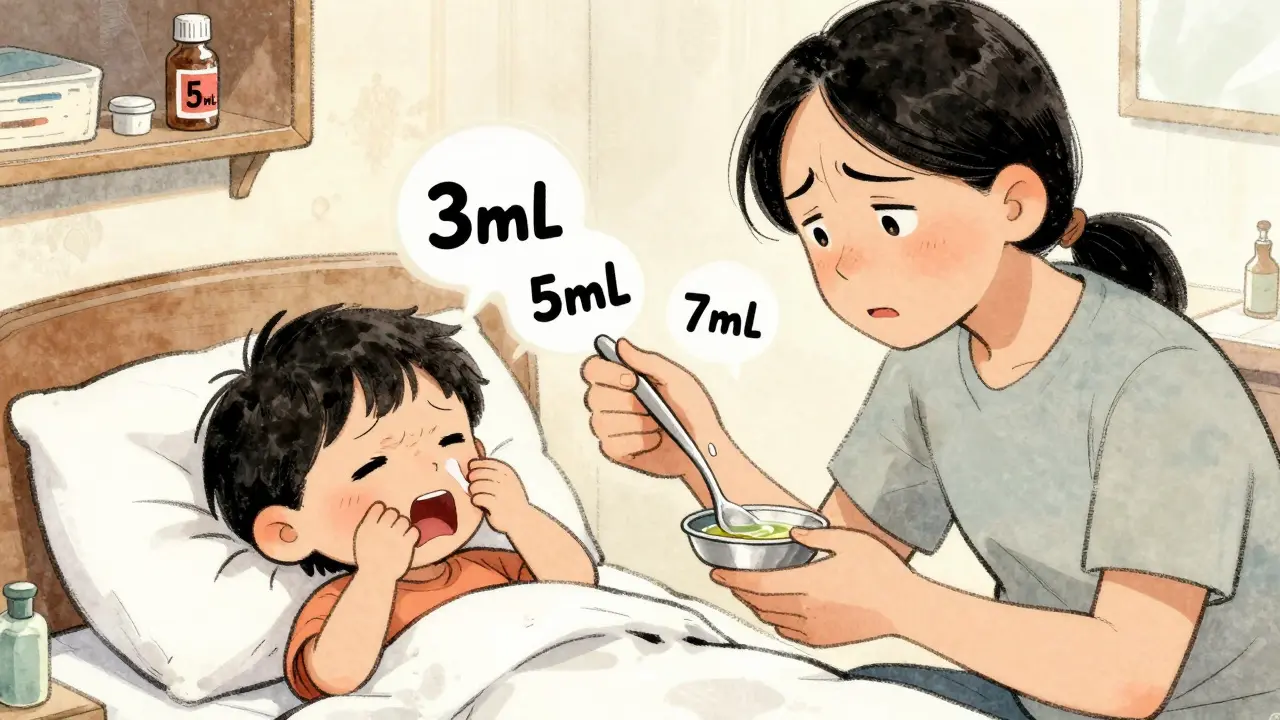
Why Your Kitchen Spoon Could Be Dangerous for Your Child’s Medicine
It seems harmless. You’re in a hurry, your child is sick, and the medicine bottle says "give 5 mL." You grab a teaspoon from the drawer and fill it to the brim. But here’s the truth: that spoon isn’t 5 mL. It might be 3 mL. Or 7 mL. And that difference? It could mean the difference between your child getting better-or ending up in the emergency room.
Every year, poison control centers in the U.S. get more than 10,000 calls about kids getting the wrong dose of liquid medicine. Most of those errors come from one simple mistake: using a kitchen spoon. It’s not laziness. It’s not ignorance. It’s because we’ve been doing it for generations. But science doesn’t care about tradition. It cares about numbers. And the numbers show that household spoons are dangerously unreliable.
The Real Size of a "Teaspoon"
A medical teaspoon is exactly 5 milliliters (mL). A tablespoon is 15 mL. Simple. Clear. Precise.
But your kitchen teaspoon? It’s not that. Research from the Consumer Medication Safety Institute shows household teaspoons hold anywhere from 3 mL to 7 mL. That’s a 40% variation. One spoon might be too little. Another might be too much. And if you’re using a tablespoon thinking it’s a teaspoon? You’re giving your child three times the dose.
That’s not a typo. Three times. If the doctor ordered 5 mL of antibiotics, and you used a tablespoon, your child just got 15 mL. That’s not a "little extra." That’s an overdose. And kids aren’t small adults. Their bodies process medicine differently. Even a small error can cause vomiting, drowsiness, breathing problems, or worse.
What the Research Says
A 2014 study published in Pediatrics, funded by the National Institutes of Health, found that nearly 40% of parents gave the wrong dose when using kitchen spoons. Over 41% made mistakes measuring the exact amount prescribed. That’s more than 2 out of 5 families.
Another study from 2016 showed that when medicine labels used the word "teaspoon," one in three parents reached for a kitchen spoon. But when the label said "5 mL," less than 10% did. The difference? Clear labeling. No jargon. No ambiguity.
And here’s the kicker: this isn’t just a problem for English speakers or people with low health literacy. The same pattern shows up across cultures, languages, and education levels. Everyone gets confused by "teaspoon." But no one gets confused by "mL."

What You Should Use Instead
There are three tools you should keep with every bottle of children’s liquid medicine:
- Oral syringe - This is the gold standard. It’s accurate down to 0.1 mL. Perfect for small doses like 2.5 mL or 3.7 mL. Most come with a cap so you can store it safely. Always use the syringe that comes with the medicine. If it didn’t come with one, ask your pharmacist for one. They’ll give it to you for free.
- Dosing cup - Only if it has clear mL markings and is designed for medicine. Kitchen measuring cups? No. These cups are often marked in 5 mL, 10 mL, 15 mL increments. That’s fine for 10 mL. But what if the dose is 7 mL? You’ll have to guess. And guessing is risky.
- Medicine dropper - Good for babies and small doses. But make sure it’s calibrated in mL, not just "drops." Drops vary by liquid thickness and dropper design. Don’t trust them unless they’re labeled with milliliters.
Never use a kitchen spoon, a regular cup, a shot glass, or a dessert spoon. Even if it looks "close enough." It’s not.
How to Measure Correctly
Using the right tool isn’t enough. You have to use it right.
- Read the label - Always check the dose in mL. If it says "tsp," ask your pharmacist to rewrite it in mL. Most will do it.
- Measure at eye level - Hold the syringe or cup at your eye level. Don’t tilt it. Don’t look down. Look straight at the line. A slight angle can throw off the measurement.
- Use the device that came with the medicine - Don’t mix and match. The syringe from one bottle might not fit another. Stick to the one provided.
- Don’t force it down the throat - Put the syringe gently between your child’s cheek and gum. Slowly push the plunger. Let them swallow naturally. Squirting it in the back of the throat can cause choking or gagging.
- Write it down - If you’re giving medicine multiple times a day, write the time and dose on a sticky note. It’s easy to lose track when you’re tired.
What Pharmacists Want You to Know
Pharmacists see this every day. They’re the ones cleaning up the mess after a dosing error. And they’re tired of it.
Aspirus Pharmacy, for example, now gives every parent a free oral syringe with any liquid pediatric prescription. They’ve seen error rates drop by nearly half since they started doing it.
"If we’re not measuring it correctly," says Olivia Bishop, a pharmacy resident, "we can either be overdosing our patients, which puts them at risk of side effects, or underdosing, which means the infection or issue we’re treating isn’t being addressed."
And it’s not just about safety. Underdosing means the medicine doesn’t work. That means the infection lingers. Your child stays sick longer. You end up back at the doctor. More visits. More stress. More cost.

Why Labels Still Say "Teaspoon"
You might wonder: if this is such a big problem, why hasn’t it been fixed?
The FDA and the American Academy of Pediatrics have been pushing for milliliter-only labeling since the 1970s. But not all manufacturers have changed. Some still print "tsp" or "teaspoon" on labels because it’s cheaper, or because they assume parents know what it means.
But here’s the thing: parents don’t know. And they shouldn’t have to guess.
The good news? More companies are switching. More pharmacies are handing out syringes. More hospitals are training staff to say "mL" every single time. And the CDC’s "Spoons are for Soup" campaign is finally getting traction.
What You Can Do Today
You don’t need to wait for a law or a new label. You can fix this right now.
- Go to your medicine cabinet. Find every liquid medicine for kids.
- Check the dosing instructions. If it says "teaspoon," "tsp," or "tablespoon," throw it out.
- Call your pharmacy. Ask them to send you a free oral syringe with mL markings.
- When you pick up a new prescription, say: "Can I get a syringe with this?" If they say no, ask why. Push back. Your child’s safety matters.
- Teach every caregiver: grandparents, babysitters, daycare staff. Show them how to use the syringe. Don’t assume they know.
This isn’t about being perfect. It’s about being safer than yesterday.
What Happens When You Get It Right
When you use a calibrated oral syringe and measure in mL, you eliminate the guesswork. You stop worrying about whether your spoon is "close enough." You stop second-guessing the dose.
Your child gets the right amount. The medicine works. They feel better faster. You sleep better at night.
And if you ever forget? Remember this: Milliliters are for medicine. Spoons are for soup.
Can I use a kitchen measuring spoon if I don’t have a syringe?
No. Kitchen measuring spoons are designed for cooking, not medicine. Even if you have a set labeled "1 tsp," they’re not calibrated to medical standards. The FDA and CDC warn against using them because they still vary by brand and wear over time. Always use the syringe or dosing cup provided with the medicine-or ask your pharmacist for one.
What if the medicine doesn’t come with a syringe?
Ask your pharmacist for one. They are required to provide a proper measuring device with any liquid pediatric medication. If they say they don’t have one, ask them to order it. Most pharmacies keep them in stock. If they refuse, go to another pharmacy. Your child’s safety is non-negotiable.
Is it okay to use a dropper instead of a syringe?
Only if it’s marked in milliliters and you can read it clearly. Many droppers don’t have accurate markings, and the size of a "drop" changes depending on the liquid’s thickness. Oral syringes are more reliable because they have clear, precise lines and you control the flow. For doses under 5 mL, always choose a syringe.
Why do some labels still say "teaspoon"?
Because not all manufacturers have updated their labels. The FDA and AAP have recommended milliliter-only labeling since the 1970s, but enforcement is slow. Always convert "tsp" or "teaspoon" to mL in your head: 1 tsp = 5 mL, 1 tbsp = 15 mL. Then use a syringe to measure that amount. Don’t rely on the label-rely on the tool.
Can I reuse a syringe for different medicines?
No. Always use a clean syringe for each medicine. Even if you rinse it, residue can mix and cause unexpected reactions. If you’re giving multiple medicines, get a separate syringe for each one. Pharmacies often give them out for free. Keep them labeled with masking tape so you don’t mix them up.
What should I do if I think I gave the wrong dose?
Call your local poison control center immediately. In New Zealand, that’s the National Poisons Centre at 0800 764 766. Don’t wait for symptoms. Don’t try to make your child vomit. Just call. They’ll tell you what to do next. Most errors are fixable if caught early.


This is such an important post. I work in pediatric nursing and see this mistake all the time. A kitchen teaspoon can vary by up to 40% - that’s not just risky, it’s terrifying. Always use the syringe. Always. Even if the dose is small. Even if you think you know what "a teaspoon" means. Science doesn’t care what you think. It cares about milliliters.
Pharmacists should hand out syringes with every prescription. No exceptions.